



Most people with disabilities leave thousands of dollars unclaimed every year because they don’t understand disability property tax exemption vs IRS Schedule R. Both programs cut your tax bill, but they work at different government levels and deliver different dollar amounts. Property tax exemptions reduce what you owe on your home at the state or local level. Schedule R is a federal tax credit that cuts your income tax directly. You can claim both at once, but most people miss one or both because the rules seem confusing.
This guide shows you precisely how each program works and who qualifies. You’ll learn the specific dollar amounts you can save with property tax exemption for disabled homeowners versus the Schedule R tax credit eligibility requirements. We break down how to apply for state property tax relief, how to file Schedule R on your federal return, and whether you can stack both benefits. You’ll also see how Rocket Records helps you claim federal disability tax credits 2026 and local exemptions at the same time without dealing with multiple agencies on your own.
The difference between disability property tax exemption vs IRS Schedule R comes down to where the money gets saved and how much you can claim. Let’s start with property tax exemptions and how they work at the state level.
What Is a Disability Property Tax Exemption and How Does It Work?
A disability property tax exemption cuts or removes the annual tax you pay on your home. You qualify based on your disability status. The program helps disabled homeowners keep more money each month.
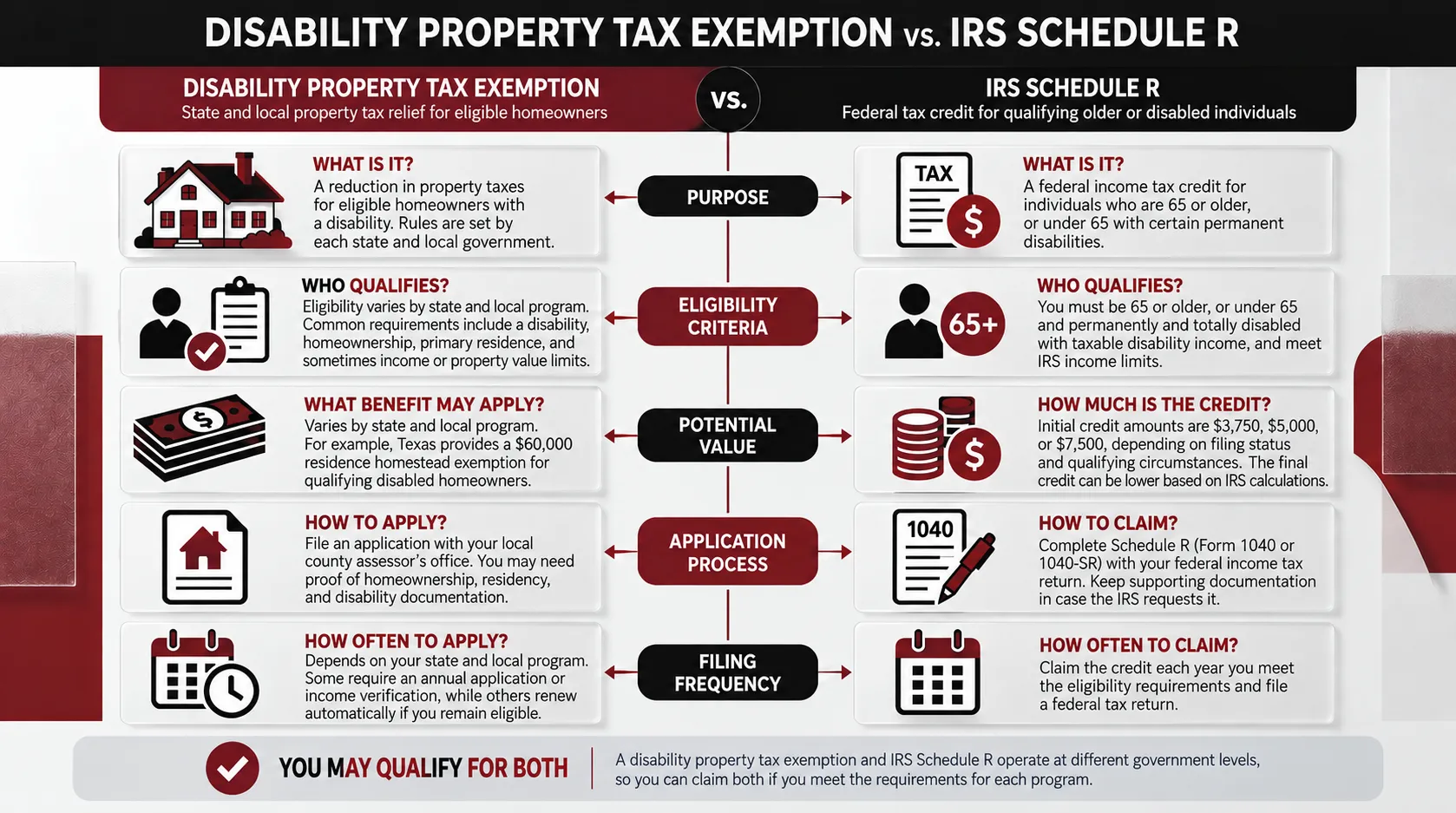
These programs run at the state and county level. That means rules change based on where you live. Dollar amounts vary too. Some states offer $500 per year. Others waive your entire tax bill. Read the full breakdown of property tax exemption.
How Disability Eligibility Varies by State and Local Program
Each state sets its own rules. Most require medical proof that your disability limits work or daily tasks. You need documentation from a doctor. Some states accept Social Security disability letters.
California offers up to $161,000 in assessed value reduction. Texas provides full exemptions for certain disabilities. Florida caps exemptions at $500 annually. New York bases amounts on income and disability type.
Permanent vs Temporary Exemptions
Some states grant permanent exemptions. You apply once and keep the benefit. Other states require annual recertification. You submit new paperwork each year.
The type depends on your disability. Permanent disabilities often get permanent exemptions. Temporary conditions need yearly proof. Check your county assessor’s office for specific rules.
Separate Programs, Separate Eligibility Requirements
Property tax exemptions differ from IRS Schedule R. They’re run by different government levels. States handle property tax breaks. The federal government manages Schedule R.
You can qualify for both programs. But approval for one doesn’t guarantee the other. Each has unique income limits and disability definitions. Apply to both separately to maximize your savings.
What Is IRS Schedule R and How Does the Credit for the Elderly or Disabled Work?
IRS Schedule R is a federal tax credit designed for people who are 65 or older, or under 65 and permanently and totally disabled. This is not a general federal disability tax credit. It is a specific program with strict federal eligibility requirements. Schedule R calculates a federal tax credit that can reduce your federal income tax liability, subject to IRS income and tax-liability limits.
Federal Tax Credit vs Tax Deduction Explained
Understanding the difference between a tax credit and a tax deduction is key. A deduction lowers your taxable income. A credit cuts your actual tax bill dollar for dollar. Schedule R is a credit, which means it provides more direct savings than a deduction of the same amount.
For example, a $3,000 deduction might save you $600 in taxes if you’re in the 20% bracket. A $3,000 credit saves you the full $3,000. This makes federal tax credits like Schedule R far more valuable than deductions for most people.
Specific Federal Eligibility Requirements for Schedule R
To qualify for Schedule R, you must meet one of two conditions. First, you are 65 or older by the end of the tax year. Second, you are under 65 and permanently and totally disabled.
If you’re under 65, you must have taxable disability income. You also must be unable to engage in substantial gainful activity. This means your condition prevents you from working in a meaningful way. The disability must be permanent or expected to last at least 12 months.
The credit phases out at higher income levels. Specific thresholds depend on your filing status. The IRS applies different AGI limits based on filing status. For the 2025 tax year, the limits are $17,500 for single, head-of-household, or qualifying surviving spouse filers; $20,000 when married filing jointly and only one spouse qualifies; and $25,000 when both spouses qualify.
How Schedule R Reduces Your Tax Liability
Credit amounts range from $3,750 to $7,500 depending on your filing status and adjusted gross income. The exact amount is calculated using the Schedule R worksheet. You claim the credit on Form 1040 when you file your annual return.
The worksheet accounts for your nontaxable Social Security and other nontaxable pensions. It also factors in your adjusted gross income. The result is a final credit amount that directly reduces what you owe the IRS. This can mean hundreds or thousands of dollars back in your pocket each year.
Primary Differences Between Property Tax Exemptions and Schedule R Credits
Property tax exemptions and Schedule R credits work at different government levels. They also target different types of taxes.
Level of Government: State vs Federal
Property tax exemptions come from state and local governments. Each state sets its own rules and benefit amounts. For the federal rules, see the IRS Schedule R instructions.
Schedule R is a federal tax credit. The IRS manages it through your annual tax return. You claim it on Form 1040.
Type of Tax Relief: Property Tax vs Income Tax
Property tax exemptions reduce what you owe on real estate. You must own a home to qualify. The savings show up in your annual property tax bill.
Schedule R is a federal income tax credit for qualifying individuals who meet the IRS age or disability requirements and applicable income limits. Homeownership is not required.
Dollar Value Comparison
Property tax exemptions vary widely by state and home value. Some states offer $500 in relief. Others provide $5,000 or more.
Schedule R provides a fixed credit based on filing status. Single filers can get up to $3,750. Joint filers can claim up to $7,500.
Property tax exemptions don’t phase out at higher incomes in most states. Schedule R phases out once your income exceeds certain thresholds.
You can claim both benefits at once if you meet each program’s requirements. Property tax exemptions often need annual applications. Schedule R gets claimed on your federal return each year.
Who May Qualify for Disability Property Tax Exemptions?
Property tax exemptions help disabled homeowners reduce their annual tax burden. But you need to meet specific criteria to qualify.
Medical Documentation Requirements
Most states require certification from a licensed physician. The doctor must confirm your disability is permanent and limits major life activities. For a deeper look, see who qualifies for disability benefits.

Some states accept Social Security disability determinations automatically. This speeds up the approval process if you already receive SSDI or SSI benefits.
Conditions like diabetes, heart disease, mobility impairments, and chronic pain can qualify. They must meet your state’s disability standards to be approved.
State-Specific Disability Definitions
Each state defines disability differently for property tax purposes. What qualifies in California may not qualify in Texas.
Veterans with service-connected disabilities often get enhanced exemptions. These can be larger than standard disability exemptions.
Income Limits and Homeownership Requirements
Income thresholds vary widely by state. Many set limits between 150% and 400% of the federal poverty level.
You must own and occupy the property as your primary residence. Rental properties and second homes don’t qualify.
Some states also cap total household assets. Check your local assessor’s office for exact requirements.
Who May Qualify for the IRS Schedule R Credit?
The IRS Schedule R credit helps people reduce their tax bill. You don’t need to guess if you qualify. Clear rules tell you exactly who can claim this benefit.
Age-Based Qualification: 65 and Older
If you turn 65 by December 31 of the tax year, you meet the age requirement. That’s it. No other health documentation is needed for this path.
You can claim the credit even if you work full-time. Your employment status doesn’t matter. The IRS only cares about your age and income level.
Disability-Based Qualification: Under 65
People under 65 can qualify through permanent and total disability. You must be retired on permanent and total disability. You also need taxable disability income to claim the credit.
Permanent and total disability means you can’t do substantial gainful activity. A physical or mental condition must cause this limitation. Your physician must certify that your disability will last 12 months or more, or result in death.
Many people with diabetes qualify when complications affect their daily function. Diabetic neuropathy, retinopathy, and kidney disease often meet this standard. Understanding which specific health conditions qualify for disability benefits helps you determine if you meet the medical criteria.
Income Limits and Phase-Out Thresholds
Income limits for 2026 start at $17,500 adjusted gross income for single filers. Married couples filing jointly face phase-out starting at $20,000 AGI. The credit reduces as your income rises above these thresholds.
Nontaxable Social Security benefits reduce your credit amount dollar-for-dollar. This means if you get $5,000 in Social Security, your credit drops by that same amount. The IRS counts these benefits even though they don’t appear on your tax return as income.
You can still claim the credit if your income exceeds the threshold. The amount just gets smaller as your AGI increases. Most people phase out completely around $25,000 for single filers and $32,500 for joint filers.
How Much Money Can You Save with Each Benefit?
The financial impact of disability property tax exemption vs IRS Schedule R varies widely based on where you live and your filing status. Both programs offer real savings. But the amounts differ dramatically depending on state law, property value, and household income.
How Property Tax Relief Varies by State and Local Program
Property tax exemptions for disabled homeowners range from $200 to over $5,000 per year. The exact amount depends on your state’s disability exemption rules and your home’s assessed value. Some states offer a flat dollar reduction. Others reduce your taxable assessed value by a percentage.
For example, Texas provides a $60,000 residence homestead exemption for qualifying homeowners who are disabled or 65 or older, with additional local exemptions possible. In a county with a 2% tax rate, that saves $200 per year. Florida offers similar relief with exemptions up to $50,000 in assessed value for totally disabled homeowners. Keep in mind that the actual tax savings depend on the applicable local tax rate and other exemptions.
California provides a more modest exemption. But high property values mean the dollar savings can still reach $1,000 or more annually. States without income tax often provide more generous property tax relief to offset the lack of other disability benefits.
Schedule R Credit Amounts by Filing Status
Schedule R provides a federal tax credit that directly reduces what you owe the IRS. Single filers can claim up to $3,750. Married couples filing jointly with one qualifying spouse can claim up to $5,000. If both spouses qualify, the credit jumps to $7,500.
The actual credit amount depends on your nontaxable income. This includes Social Security benefits and other nontaxable pensions. Higher nontaxable income reduces your credit. But most disabled homeowners on fixed incomes receive the full amount or close to it.
Combined Savings Potential
Claiming both benefits at once can save between $4,000 and $12,500 per year. Lower-income disabled homeowners see the highest combined savings. They often qualify for the maximum Schedule R credit and substantial state property tax relief.
For example, a married couple in Texas with both spouses disabled could save $7,500 from Schedule R plus $400 from property tax exemptions. That’s $7,900 in annual savings. Add in other state-specific programs, and the total climbs even higher.
How to Apply for Disability Property Tax Exemptions
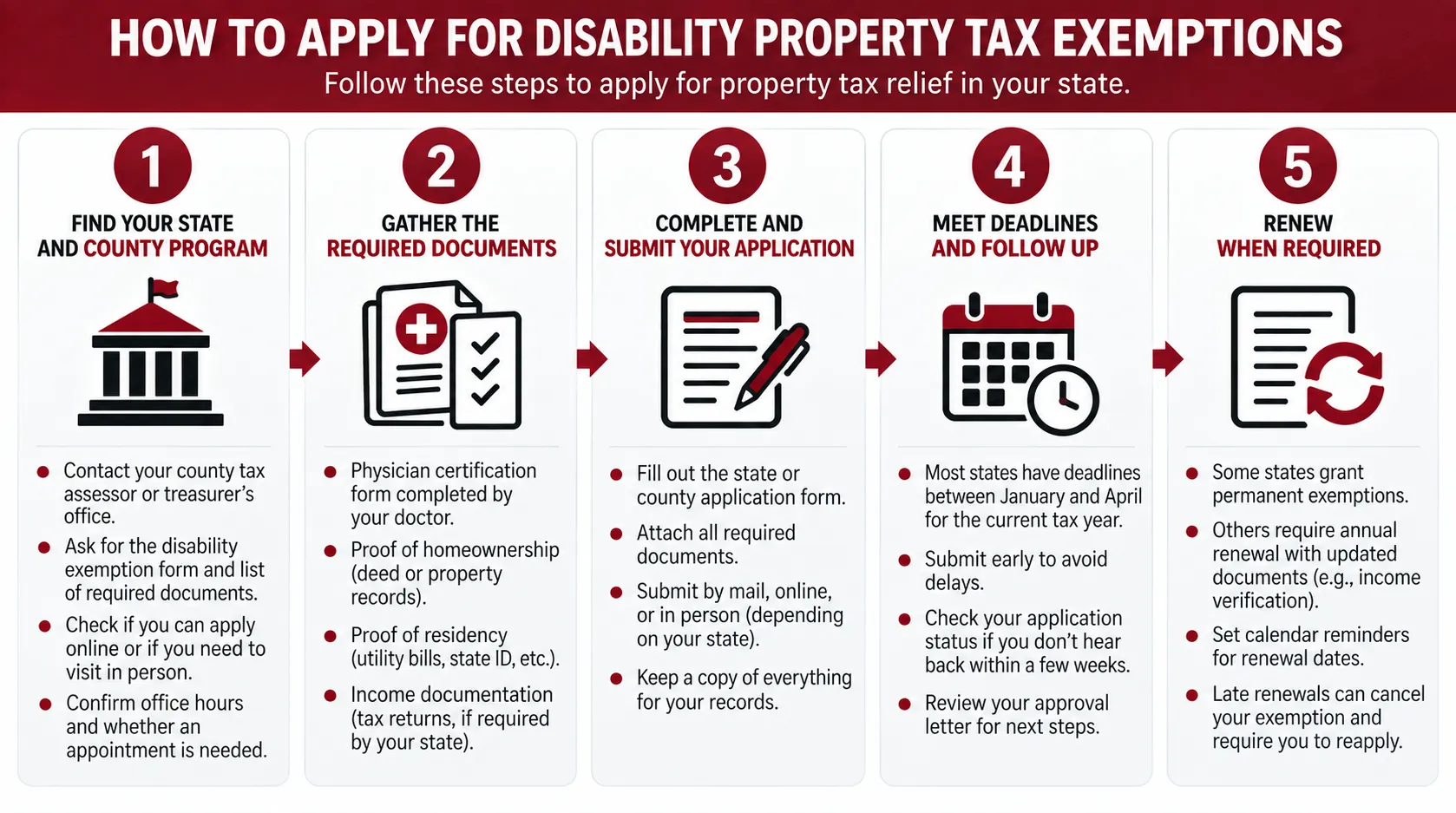
Applying for property tax exemptions for disabled homeowners starts with your local tax office. Each state runs its own program with different rules and deadlines. You need to know where to apply and what documents to bring.
Finding Your State and County Program
Contact your county tax assessor or treasurer’s office first. They handle disability property tax relief applications in most states. Ask for the disability exemption form and a list of required documents.
Some states post applications online. Others require you to visit in person. Call ahead to confirm office hours and whether appointments are needed. This saves time and avoids multiple trips.
Rocket Records identifies your state-specific property tax exemption program automatically. The platform shows you which office to contact and what forms you need. This cuts research time from hours to minutes.
Required Documentation and Forms
Most states require a physician certification form. Your doctor must document your disability and how it limits daily activities. This form proves you meet the state’s definition of disabled.
You also need proof of homeownership, residency, and income. Bring your deed, utility bills, and tax returns. Some states set income limits for eligibility. Check your state’s threshold before applying.
Understanding how to apply for disability benefits online helps you gather the right paperwork faster. Rocket Records prepares all required documentation automatically once you enter your health information.
Application Deadlines and Renewal Requirements
Deadlines vary by state. Most fall between January and April for the current tax year. Missing the deadline means waiting another full year for relief.
Some states grant permanent exemptions after approval. Others require annual renewal with updated income verification. Check your approval letter for renewal instructions.
Set calendar reminders for renewal dates. Late renewals can cancel your exemption and require reapplying from scratch. Rocket Records sends renewal reminders so you never miss a deadline.
How to Claim IRS Schedule R on Your Federal Tax Return
Claiming Schedule R requires completing three distinct parts of the form. Each part builds on the previous one. You start by determining your base credit amount. Then you reduce it based on nontaxable income. Finally, you apply income limits to calculate your final credit.
Completing Schedule R Form 1040
Download Schedule R from IRS.gov or use tax software that includes the form. Most major tax programs like TurboTax and H&R Block automatically include Schedule R. According to the IRS Credit for Elderly or Disabled, you must be 65 or older, or under 65 and permanently disabled to qualify.
Part I determines your initial credit amount based on filing status. Single filers start with $5,000. Married filing jointly starts at $7,500 if both spouses qualify. Head of household begins at $5,000. These amounts represent your base before any reductions.
Calculating Your Credit Amount
Part II reduces your base amount by nontaxable Social Security and pensions. You subtract these from your initial figure. This step accounts for income you already receive tax-free. The goal is to avoid double benefits.
Part III applies income limits and phase-out calculations. Your credit phases out as your adjusted gross income rises. The phase-out starts at different thresholds based on filing status. Single filers begin phasing out at $17,500. Married filing jointly starts at $25,000. The credit reduces by 50% of income above these thresholds.
Common Mistakes to Avoid
Transfer your final credit amount to Schedule 3 Form 1040 line 6d. Many people forget this step. Your credit won’t apply unless you complete the transfer. Keep physician certification of disability on file in case of IRS audit. You don’t submit it with your return. You only need it if the IRS requests verification later.
Tax software automatically calculates Schedule R if you answer qualifying questions correctly. Answer all health and age questions accurately. The software uses your responses to determine eligibility. It then completes all three parts of Schedule R for you.
Can You Claim Both Benefits at the Same Time?
Yes, you can claim both disability property tax exemptions and IRS Schedule R at the same time. These programs operate at different government levels. Property tax relief comes from state and local authorities. Schedule R is a federal tax credit.
This means they don’t conflict with each other. You can reduce your state property taxes while also lowering your federal income tax. Both benefits work together to cut your overall tax burden.
Federal vs State Tax Benefits Do Not Conflict
Property tax exemptions reduce what you owe to your county or municipality. Schedule R reduces what you owe to the IRS. Because they target different tax systems, claiming one doesn’t affect your eligibility for the other.
Most states allow you to stack multiple disability benefits. This includes property tax relief alongside federal credits. According to Washington state disability tax relief guidelines, homeowners can claim state exemptions while also filing Schedule R federally.
When You May Qualify for One Benefit but Not the Other
Each program has its own eligibility rules. You might qualify for property tax relief but not Schedule R if your income exceeds federal thresholds. The Schedule R credit phases out at higher income levels.
On the other hand, you might qualify for Schedule R but not property tax relief if you don’t own a home. Property tax exemptions only apply to homeowners. Renters can’t claim this benefit.
Documentation That Works for Both Programs
The same physician certification letter often satisfies both programs. Most states and the IRS accept similar disability documentation. Social Security disability determinations work for both benefits in most cases.
This means you don’t need to get separate medical letters. One comprehensive disability certification can support both applications. Keep copies of all documentation for your records.
How Rocket Records Helps You Claim Property Tax Exemptions and Schedule R Together
Rocket Records simplifies the process of claiming both state property tax exemptions for disabled homeowners and federal Schedule R tax credits. The platform analyzes your health status and location to match you with every benefit you qualify for.
AI-Powered Benefit Matching
The platform scans your health conditions against thousands of federal and state programs. It identifies property tax exemptions based on your disability status and state of residence. You also see Schedule R eligibility if your condition meets IRS requirements.
Most users discover benefits they never knew existed. The system cross-references disability tax benefits comparison data to show you the highest-value programs first. This saves hours of research across multiple government websites.
Pre-Filled Paperwork and Documentation
Rocket Records generates pre-filled applications for state property tax exemptions. It also prepares Schedule R documentation ready to attach to your tax return. You receive a personalized benefits dashboard showing the estimated annual value of each program.
The platform handles the complexity of Schedule R tax credit eligibility requirements. You don’t need to interpret IRS forms or state tax codes yourself. Everything arrives ready to submit.
Tracking and Renewal Reminders
The platform tracks your application status across all programs. You get renewal reminders so benefits don’t lapse due to missed deadlines. Over 250,000 Americans have used Rocket Records to claim disability benefits, with an average savings of $12,450 per year.
A free tier identifies all eligible benefits upfront. The premium plan starts at $19.99 per month and includes full paperwork assistance.
Conclusion
You now know how disability property tax exemption vs IRS Schedule R work together to cut your tax burden. Property tax exemptions reduce what you owe locally on your home. Schedule R cuts your federal income tax bill directly. Both programs target people with disabilities but operate at different government levels.
Most disabled homeowners can claim both benefits at once. The combined savings range from $4,000 to $12,500 per year. That’s real money back in your pocket. You just need to apply to your county tax office for property exemptions. Then file Schedule R with your federal tax return.
The application process differs for each benefit. Property tax exemptions for disabled homeowners require local documentation and annual renewal in some states. Schedule R needs income verification and proof of permanent disability. But the effort pays off year after year.
Don’t leave this money on the table. Take the Rocket Records benefit eligibility quiz now to see which programs you qualify for. You’ll get a personalized dashboard showing every available benefit, estimated savings, and pre-filled forms ready to submit. Start claiming what you’re entitled to today.






 Ask ChatGPT
 Ask Claude
 Ask Perplexity