


You know something is wrong. You cannot work the way you used to. Maybe you have already missed paychecks. Maybe you are worried about how long you can hold on. And now you are staring at the Social Security Administration website wondering where to even start.
Here is the good news. You can apply for disability benefits entirely online, and this guide walks you through every step.
Knowing how to apply for disability benefits online the right way makes a real difference. According to the Social Security Administration, approximately 62% of initial disability applications were denied in 2024. Most of those denials happened not because the person didn’t qualify, but because of incomplete documentation or application errors. Getting it right the first time matters.
By the end of this guide you will know whether you qualify for SSDI or SSI (or both), exactly what documents to gather, how to complete the online application step by step, what to expect after you submit, and how to avoid the mistakes that delay or deny claims.
And you will learn something most people miss: SSDI and SSI are just two of dozens of disability-related benefits you may qualify for. Many people leave thousands of dollars on the table every year simply because they didn’t know to look.
SSDI vs. SSI: Which Disability Program Are You Applying For?
Before you start your application, you need to know which program you are applying for. The Social Security Administration runs two separate federal disability programs. Most people don’t know the difference before they apply.
Social Security Disability Insurance (SSDI) is based on your work history. To qualify, you must have worked long enough and paid Social Security taxes. The SSA uses a system of work credits to measure this. In 2026, you earn one credit for every $1,890 in wages or self-employment income, up to four credits per year. The number of credits you need depends on your age when your disability begins.
Supplemental Security Income (SSI) is different. It is needs-based, meaning it does not require a work history. But it does have strict income and asset limits. In 2026, your income generally cannot exceed $994 per month to qualify for SSI, and you cannot have more than $2,000 in countable assets ($3,000 for couples).
You can apply for both programs at the same time. The SSA will determine which one you qualify for — or whether you qualify for both, which is called concurrent benefits. When in doubt, apply for both and let the SSA sort it out.
SSDI vs. SSI at a Glance
| SSDI | SSI |
|---|---|
| Based on work history and Social Security taxes paid | Based on financial need — no work history required |
| Must have enough work credits to qualify | Income limit: approximately $994/month in 2026 |
| No income or asset limits (beyond SGA threshold) | Asset limit: $2,000 individual / $3,000 couple |
| Leads to Medicare after 24 months of benefits | Leads to Medicaid in most states immediately |
| Average monthly benefit: approximately $1,537 (2024) | Maximum monthly benefit: $943 individual (2026) |
| 5-month waiting period before benefits begin | Benefits can begin the month after application date |
One more thing worth knowing before you apply: SSDI and SSI are federal programs managed by the SSA. But there are also state disability programs, employer-based benefits, tax credits, prescription savings, and more that you may qualify for at the same time. Most people never find out about them.
Do You Qualify? Eligibility Requirements Explained
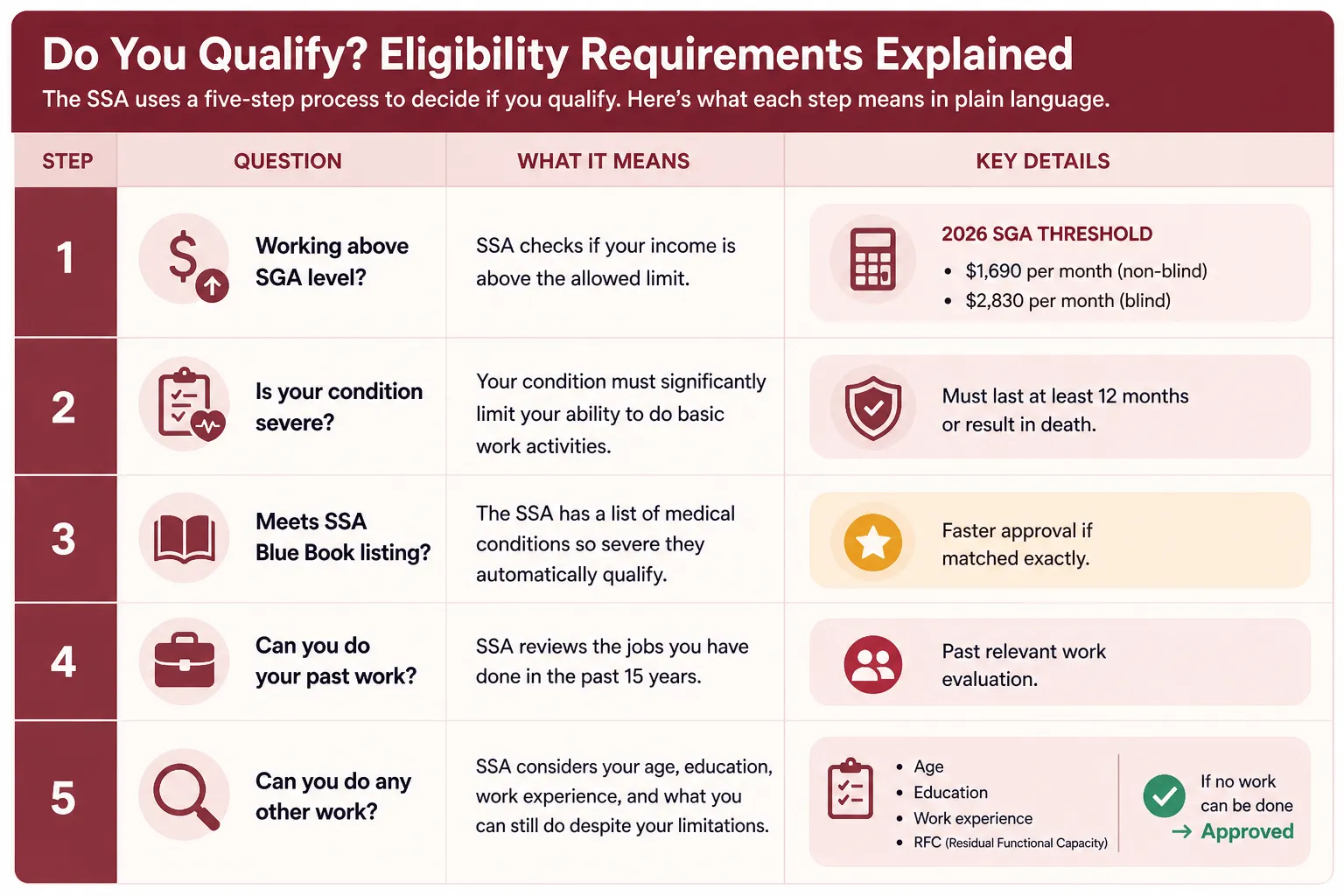
The SSA uses a five-step process to decide if you qualify. You can review the full criteria on the SSA’s official eligibility. Here is what each step means in plain language.
-
Are you working above the Substantial Gainful Activity (SGA) level? SGA is the monthly earnings amount the SSA considers significant. In 2026, that threshold is $1,690 per month for non-blind individuals and $2,830 for blind individuals. If you earn more than this, you generally cannot be considered disabled under SSA rules.
-
Is your condition severe enough? Your condition must significantly limit your ability to do basic work activities, things like standing, walking, lifting, sitting, or remembering, for at least 12 consecutive months, or be expected to result in death.
-
Does your condition meet a listing in the SSA Blue Book? The SSA maintains a list of medical conditions so severe they automatically qualify as disabilities. These are called impairment listings. If your condition matches a listing exactly, you may be approved faster.
-
Can you still do your past work? The SSA will look at the jobs you have held in the past 15 years. If your condition prevents you from doing any of that work, you move to step five.
-
Can you do any other work? The SSA considers your age, education, work experience, and what is called your Residual Functional Capacity (RFC), essentially, what tasks you are still capable of performing despite your limitations. If the SSA concludes there is no work you can do, you will be approved.
Important: You Do Not Need to Be Completely Unable to Work The SSA does not require you to be bedridden or entirely incapacitated. What matters is whether your condition prevents you from doing substantial work on a consistent basis. Many people with chronic pain, mental health conditions, and intermittent symptoms qualify. Do not assume your condition is not serious enough before you check.
Common qualifying conditions include musculoskeletal disorders, heart conditions, cancer, neurological disorders, respiratory diseases, mental health conditions (depression, anxiety, PTSD, bipolar disorder), diabetes complications, and autoimmune diseases. This is not a complete list, any condition that meets the SSA’s severity standard can qualify.
What Documents Do You Need Before You Apply?
Gathering your documents before you start the application saves time and reduces errors. Incomplete applications are one of the most common reasons claims are delayed. The SSA’s online application portal allows you to save your progress and return, but having everything ready upfront makes the process much smoother.
Personal and Identity Documents
-
Social Security number and proof of age (birth certificate or passport)
-
Proof of U.S. citizenship or lawful immigration status
-
Military discharge papers (DD-214) if you served in the armed forces
-
Bank account information for direct deposit setup
Work History Documents
-
Names and addresses of all employers for the past five years
-
Your most recent W-2 forms or federal tax returns (self-employed applicants)
-
Job titles and descriptions of duties for each position
-
Dates of employment for each job
Medical Evidence
-
Names, addresses, and phone numbers of all doctors, hospitals, and clinics that have treated you
-
Names and dosages of all medications you are currently taking
-
Records of medical tests, lab results, imaging, and specialist evaluations
-
Names of any social workers, therapists, or counselors involved in your care
-
List of any medical equipment you use (wheelchair, oxygen, CPAP, etc.)
Financial Documents (Required for SSI)
-
Bank account statements for the past 12 months
-
Records of any property you own (other than your primary residence)
-
Life insurance policy information
-
Records of any other income sources
Pro Tip: Start With What You Have You do not need every document before you submit your application. The SSA can help request some records directly from your doctors. Apply as soon as you are ready, waiting costs you potential back pay. The date you apply becomes your application date, and back pay can only go back to that date.
How to Apply for Disability Benefits Online: Step by Step
The SSA offers a fully online application process. You can access it through the SSA’s official disability application portal. The application is called Form SSA-16. It typically takes 15 to 30 minutes to complete, though you can save your progress and return at any time.
-
Create or log into your my Social Security account. Go to ssa.gov/myaccount and create a free account if you don’t already have one. This is the secure portal where you will complete and track your application. You will need your Social Security number, an email address, and a U.S. mailing address.
-
Start the disability application. Once logged in, navigate to the disability section and select ‘Apply for Disability Benefits.’ The system will ask you a few screening questions to confirm you are applying for the right program. If you want to apply for both SSDI and SSI at the same time, indicate this when prompted.
-
Complete your personal information. Enter your full legal name, Social Security number, date and place of birth, contact information, and preferred language. Make sure everything matches your identity documents exactly. Discrepancies cause delays.
-
Enter your disability information. This is one of the most important sections. You will list your alleged onset date, the date your disability began preventing you from working. Be as specific and accurate as possible. You will also list every condition that affects your ability to work, not just your primary diagnosis. List all of them.
-
Complete your work history. List every employer you have worked for in the past five years. Include job titles, duties, the physical and mental demands of each job, and your earnings. The SSA uses this to assess whether you can return to past work.
-
Enter your medical information. List every doctor, clinic, hospital, therapist, and specialist who has treated you for your conditions. Include their addresses and phone numbers. List all medications you take, including dosages. Describe any medical tests you have had. The more complete this section, the less back-and-forth you will need with the SSA.
-
Review and submit. Before submitting, read through every answer carefully. Do not leave any field blank, write ‘none’ or ‘N/A’ where nothing applies. Once submitted, you will receive a confirmation number. Save it. You will need it to check your application status.
Not Sure What Else You Qualify For Beyond SSDI and SSI? Most Americans with health conditions qualify for far more than they realize. Prescription savings, tax credits, handicap parking placards, utility discounts, FMLA protection, and more, Rocket Records’ AI scans 25+ federal and state programs and finds everything you are entitled to in under 5 minutes. Check Your Eligibility Free →
What Happens After You Submit Your Application?
Submitting your application is only the beginning. Here is what happens next, based on information from USA.gov’s disability benefits guide.
First, the SSA reviews your application for basic eligibility, confirming your work credits, age, and non-medical requirements. This initial review usually takes a few weeks.
Next, your application is sent to your state’s Disability Determination Services (DDS) office. DDS is the state agency that reviews the medical side of your claim. They may request additional medical records from your doctors or schedule a Consultative Examination (CE), a medical exam paid for by the SSA, if your records don’t provide enough information.
The initial decision typically takes three to six months. Wait times have been longer in recent years due to SSA staffing challenges. As of 2024, the average wait for an initial determination was over seven months.
The Application Timeline at a Glance
| Stage | What Happens | Typical Timeframe |
|---|---|---|
| Application submitted | SSA reviews for non-medical eligibility | 2-4 weeks |
| Sent to state DDS | Medical review of your records and conditions | 3-7 months |
| Decision issued | Approval or denial notice mailed to you | After DDS review |
| If approved (SSDI) | 5-month waiting period before benefits begin | After approval date |
| If denied | 60-day window to file a request for reconsideration | Immediately after notice |
| Reconsideration | Second review of your claim by a different DDS examiner | 3-5 months |
| ALJ Hearing | Hearing before an Administrative Law Judge if denied again | 12-24 months |
If You Are Approved
Congratulations. For SSDI, there is a mandatory five-month waiting period before your monthly benefits begin. You may also receive back pay, benefits owed from your application date (or alleged onset date, whichever is later) to your approval date. Back pay can be substantial if your claim took a long time to process.
SSDI recipients become eligible for Medicare after 24 months of receiving benefits. SSI recipients typically receive Medicaid immediately in most states.
If You Are Denied
A denial is not the end. According to SSA data, approximately 62% of initial applications were denied in 2024. But many of those people went on to receive benefits through the appeals process. You have 60 days from the date of your denial notice to file a request for reconsideration. Do not miss this deadline.
The appeals process has four levels: Reconsideration, Hearing before an Administrative Law Judge (ALJ), Appeals Council Review, and Federal Court. Most successful appeals happen at the ALJ hearing stage, where approval rates jump to approximately 51%.
Common Mistakes That Delay or Deny Disability Claims
Most denials are preventable. Here are the eight most common mistakes applicants make and how to avoid them.
Mistake 1: Applying too late. Apply as soon as your disability prevents you from working. Back pay only goes back to your application date, every month you wait is money you cannot recover.
Mistake 2: Not listing all conditions. List every condition that affects your ability to work, not just your primary diagnosis. A combination of conditions, say, chronic back pain plus anxiety plus diabetes, can collectively support a stronger claim than any one condition alone.
Mistake 3: Gaps in medical treatment. The SSA needs to see consistent treatment records. If there are long gaps between doctor visits, examiners may conclude your condition is not as severe as you claim. Stay current with your medical care throughout the application process.
Mistake 4: Leaving fields blank. Never leave a field empty. Write ‘none’ or ‘N/A’ for anything that does not apply. Blank fields raise flags and slow down your review.
Mistake 5: Not being specific about limitations. Do not just list your diagnosis. Describe in detail how it affects your daily life. How far can you walk before pain stops you? How long can you sit? How often do your symptoms flare? Specific functional descriptions are what DDS examiners need to make a decision.
Mistake 6: Earning above the SGA threshold while applying. If you are earning more than $1,690 per month in 2026 (or $2,830 if blind), the SSA will generally find you ineligible regardless of your medical condition.
Mistake 7: Not appealing a denial. Many people give up after a denial. Don’t. The appeals process exists precisely because initial denials are so common. File your request for reconsideration within 60 days and keep going.
Mistake 8: Missing deadlines. The 60-day appeal window is strict. Missing it means starting the process over from scratch and losing your application date, and your potential back pay.
Other Disability Benefits You May Be Missing
SSDI and SSI get all the attention. But they are just two programs in a much larger landscape of disability-related benefits that millions of Americans qualify for and never claim.
State Disability Programs
California, New York, New Jersey, Rhode Island, and Hawaii all have state-funded short-term disability insurance programs. These can provide income replacement during the period before your federal SSDI benefits kick in, or for conditions that don’t meet the federal definition of disability but still prevent you from working temporarily.
Veterans Disability Benefits
If you served in the military, you may qualify for VA disability compensation regardless of your SSDI status. The VA disability program provides monthly payments based on your service-connected disability rating. You can receive VA disability and SSDI at the same time.
Disability Tax Credits
The IRS offers disability-related tax credits worth up to $7,500 for eligible individuals. The Earned Income Tax Credit (EITC) is available to people with disabilities who have earned income, and the Credit for the Elderly or Disabled applies to many Social Security recipients. Many people miss these credits entirely.
Benefits Most People Never Discover
Benefits Beyond SSDI and SSI
| Benefit Program | Estimated Annual Value | Who Qualifies |
|---|---|---|
| Handicap Parking Placard | $300-$500/yr in convenience | Mobility or chronic conditions |
| Prescription Assistance Programs | $1,200-$4,000/yr | Limited income, chronic conditions |
| Disability Tax Credits | $3,750-$7,500 one-time | Working-age adults with disabilities |
| Utility Discounts | $200-$400/yr | Disability or low income |
| National Park Lifetime Pass | $80 value (free) | Permanent disability |
| FMLA Leave Protection | Job security while in treatment | Workers with qualifying conditions |
| Student Loan Discharge | Up to full loan balance | Total and permanent disability |
| Medicaid Services | $2,000-$5,000/yr | SSI recipients and low income |
Most people discover one or two of these programs on their own. Finding all of them requires knowing where to look, across federal agencies, state programs, employer policies, and tax law. Rocket Records’ AI does that scan automatically, matching your health conditions to every program you qualify for across 25+ benefit categories.
Conclusion
Applying for disability benefits online is more manageable than most people expect, especially once you understand the steps. Knowing how to apply for disability benefits online the right way from the start is the single most important thing you can do to protect your claim.
Gather your documents before you begin. List every condition, not just the main one. Be specific about how your illness or injury affects your daily life. Submit as early as possible. And if you are denied, appeal within 60 days.
But remember: SSDI and SSI are just the beginning. Millions of Americans with disabilities and chronic conditions also qualify for prescription savings, tax credits, parking placards, utility discounts, and more — and most never find out. You have earned these benefits. The only question is whether you know about them.





 Ask ChatGPT
  Ask Claude
  Ask Perplexity