


You have heard about SSDI. Maybe SSI. Maybe your state has its own program. But you have no idea how they all fit together, which ones you need to apply for separately, or whether getting one affects your chance of getting another. So you keep asking yourself the most important question: who qualifies for disability benefits at each level of government?
The answer is different depending on which level you are asking about. The U.S. benefit system has three layers: federal, state, and local. Each layer has its own programs, its own eligibility rules, and its own application process. Most people only know about federal programs like SSDI and SSI, and they never find out what their state or county offers.
This guide breaks all three levels down in plain language. It covers which federal, state, and local benefits exist, how the eligibility rules differ across each level, how the programs can work together, and how Rocket Records checks all three levels at the same time so you never miss a program you are owed.
Understanding multiple disability benefits across all three government levels is the key to getting the full financial support you are entitled to. Most people who come to Rocket Records knowing about one program leave with a list of five to ten they qualify for.
The Three Levels of Government Benefits Explained
Before we get into specific programs, it helps to understand how the system is structured. According to the Benefits.gov disability programs directory, benefits come from three separate levels of government, and each level works differently.
Federal benefits are set by the U.S. Congress and run by federal agencies like the Social Security Agency. They apply the same way in all 50 states. State benefits are designed and funded by each state government, so they vary widely depending on where you live. Local benefits come from counties, cities, and townships, and they are the least well-known part of the system.
Getting a benefit from one level does not on its own give you access to benefits from another. Each level has its own application process and its own eligibility rules. That is why checking only one level and stopping there leaves so much on the table.
The Three Levels of Government Benefits at a Glance
| Level | Who Runs It | Example Programs | Eligibility Set By |
|---|---|---|---|
| Federal | U.S. Congress and federal agencies | SSDI, SSI, VA disability, Medicare | SSA, VA, and federal law |
| State | State government and legislature | CA SDI, NY DBL, state Medicaid, paid leave | Each state sets its own rules |
| Local | County, city, or township | County general assistance, transit passes | Varies by city and county |
The key insight here is that benefit bundling across all three levels is not only possible but common. A single person with a chronic health condition might receive SSDI from the federal government, a state short-term disability payment during the waiting period, and a county utility discount at the same time. None of these cancel each other out on its own.
If you are wondering will I qualify for disability benefits at more than one level, the answer is often yes. But you need to check each level separately, because the eligibility rules are different at every level.
Who Qualifies for Disability Benefits at the Federal Level
Federal programs are the largest in dollar value and the most consistent across the country. According to the Social Security Agency disability overview, about 9 million workers with disabilities receive SSDI each month, and more than 7 million people receive SSI. Here is a breakdown of the main federal programs and who qualifies for each.
SSDI: Social Security Disability Insurance
SSDI is for people who have worked and paid Social Security taxes. To qualify, you must have built up enough work credits. In 2026, you earn one credit for every $1,890 in wages or self-employment income, up to four credits per year. Most adults need 40 total credits with 20 earned in the past 10 years.
You also must earn below the SGA limit, which stands for Substantial Gainful Activity. In 2026, that limit is $1,690 per month for most people and $2,830 per month if you are blind. These numbers are in the SSA’s 2026 Red Book. If you earn more than this, the SSA will usually find you are not disabled.
SSI: Supplemental Security Income
SSI does not require a work history. It is based on financial need. In 2026, the income limit is $994 per month for persons and $1,491 per month for couples. The asset limit is $2,000 for a single person and $3,000 for a couple. Your home and one car do not count toward the asset limit.
You can apply for both SSDI and SSI at the same time. The SSA will evaluate both and tell you which one you qualify for, or whether you qualify for both at once. If you qualify for both, that is called concurrent benefits.
Other Key Federal Programs
-
VA Disability Pay: Veterans with a health condition connected to their military service may qualify for monthly payments from the VA. According to VA.gov disability compensation, you can receive VA disability pay at the same time as SSDI with no offset between them.
-
FMLA Leave: The Family and Medical Leave Act protects your job while you get treatment for a serious health condition. This does not pay you, but it keeps your job safe for up to 12 weeks per year. A state-licensed physician must complete the required certification form.
-
Federal Prescription Savings (Extra Help / LIS): This federal program helps people with Medicare pay for prescription drugs. It is available to people with low income and limited assets, and it can reduce drug costs a lot each month.
-
Student Loan Discharge: People with total and permanent disability can have their federal student loans cleared entirely. This is a federal benefit that most people never find out about.
Key Federal Disability Programs at a Glance
| Program | Who Qualifies | Value (2026) |
|---|---|---|
| SSDI | Workers with disability and work credits | Avg. $1,537/month |
| SSI | Low-income adults with disability | Up to $994/month |
| VA Disability Pay | Veterans with service conditions | Based on rating |
| FMLA Leave | Workers needing medical leave | Job protection, no offset |
| Federal Prescription Savings | Low-income Medicare recipients | Reduces drug costs |
| Student Loan Discharge | Total and permanent disability | Full loan balance cleared |
Knowing which disabilities qualify for disability benefits at the federal level is just the first step. The condition must limit your ability to work for at least 12 months in a row. The SSA uses both a Blue Book of listed conditions and an RFC review for conditions that are not listed.
If you want to know how to apply for disability benefits online at the federal level, the SSA has a fully online application at ssa.gov. Rocket Records can also pre-fill and submit your federal applications.
Who Qualifies for Disability Benefits at the State Level
State programs add a layer of support on top of federal benefits. The rules are set by each state, so what is available in California may not exist in Texas. But many states offer programs that can fill the gap while you wait for federal benefits to be approved. The USA.gov disability benefits overview notes that state programs are very useful during the SSDI five-month waiting period, when no federal payment is coming in yet.
State Short-Term Disability Insurance
Five states require employers to provide short-term disability insurance as part of employment. These are California, New York, New Jersey, Rhode Island, and Hawaii. If you live in one of these states and cannot work due to a health condition, you may qualify for weekly payments while you recover or wait for your federal application to be processed.
These state programs do not use the SSA’s medical standard. They have their own, usually simpler, eligibility rules. In many cases, you just need a doctor to confirm that you cannot work due to your health condition.
States With Mandatory Short-Term Disability and Paid Leave Programs
| State | Program Name | Maximum Weekly Benefit (approx. 2026) |
|---|---|---|
| California | State Disability Insurance (SDI) | Up to $1,620/week |
| New York | Disability Benefits Law (DBL) | Up to $170/week |
| New Jersey | Temporary Disability Insurance (TDI) | Up to $1,055/week |
| Rhode Island | Temporary Disability Insurance (TDI) | Up to $1,007/week |
| Hawaii | Temporary Disability Insurance (TDI) | Up to 58% of weekly wages |
State Paid Family Leave Programs
A growing number of states now offer paid family leave programs. These are separate from short-term disability and cover time off to care for a seriously ill family member or bond with a new child. States with paid family leave programs include California, New York, New Jersey, Connecticut, Washington, Colorado, Massachusetts, and Oregon, among others.
These programs can be very useful for caregivers who do not have a disability themselves but need time away from work to support a family member who does.
State Medicaid and Medicaid Expansion
Medicaid is a federal and state program that covers health care for people with low income. But the expansion of Medicaid under the Affordable Care Act means that in most states, adults with income up to 138% of the federal poverty level qualify, whether or not they have a disability.
If you receive SSI, you usually qualify for Medicaid right away in most states. If you receive SSDI, you qualify for Medicare after 24 months of benefits. Some people qualify for both Medicare and Medicaid at the same time, which is called dual eligible status.
State Prescription Assistance and Other State Programs
Many states run their own prescription savings programs on top of the federal Extra Help program. State vocational job support programs are available in all 50 states to help people with disabilities return to work with job training, equipment, and support. State property tax exemptions for people with disabilities are also common, though the amounts vary widely.
The eligibility and benefits verification process for state programs is separate from the federal process. You need to check your own state’s rules, which are different from the SSA standards.
Find Benefits From All Three Government Levels in One Search.
Most people check federal programs and stop there. Rocket Records’ AI scans federal, state, and local programs all at once and shows you every benefit you qualify for in under five minutes. State-licensed physicians handle your medical forms.
Check All Three Levels at RocketRecords
Who Qualifies for Disability Benefits at the Local Level
Local government benefits are the most missed part of the system. County offices, city programs, and municipal services offer real, meaningful help to people with disabilities, but most people never find out these programs exist because they are not well known the way federal programs are.
County General Assistance
Most counties in the U.S. have some form of general assistance or general relief program. These provide small monthly cash payments to people who do not yet qualify for SSDI or SSI. The eligibility rules are usually based on where you live and your income, not on a formal disability decision. This makes county general assistance one of the most accessible programs for people who are in the process of applying for federal benefits.
The amount is usually low, often between $150 and $400 per month, but it can help cover basic costs during the long wait for a federal decision.
Local Transportation Assistance
Most cities and counties offer reduced-fare or free transit passes for people with disabilities. Some areas go further and offer door-to-door special transit services for people whose condition prevents them from using standard public transit. These programs are run at the local level and funded by a mix of city, state, and federal dollars.
Local Utility and Housing Help
On top of the state and federal utility assistance programs, many counties and cities run their own energy bill discount programs. Local housing authorities also maintain waitlists for accessible and affordable housing, and some areas offer property tax deferrals or freezes for disabled homeowners and seniors.
How to Find Local Benefits in Your Area
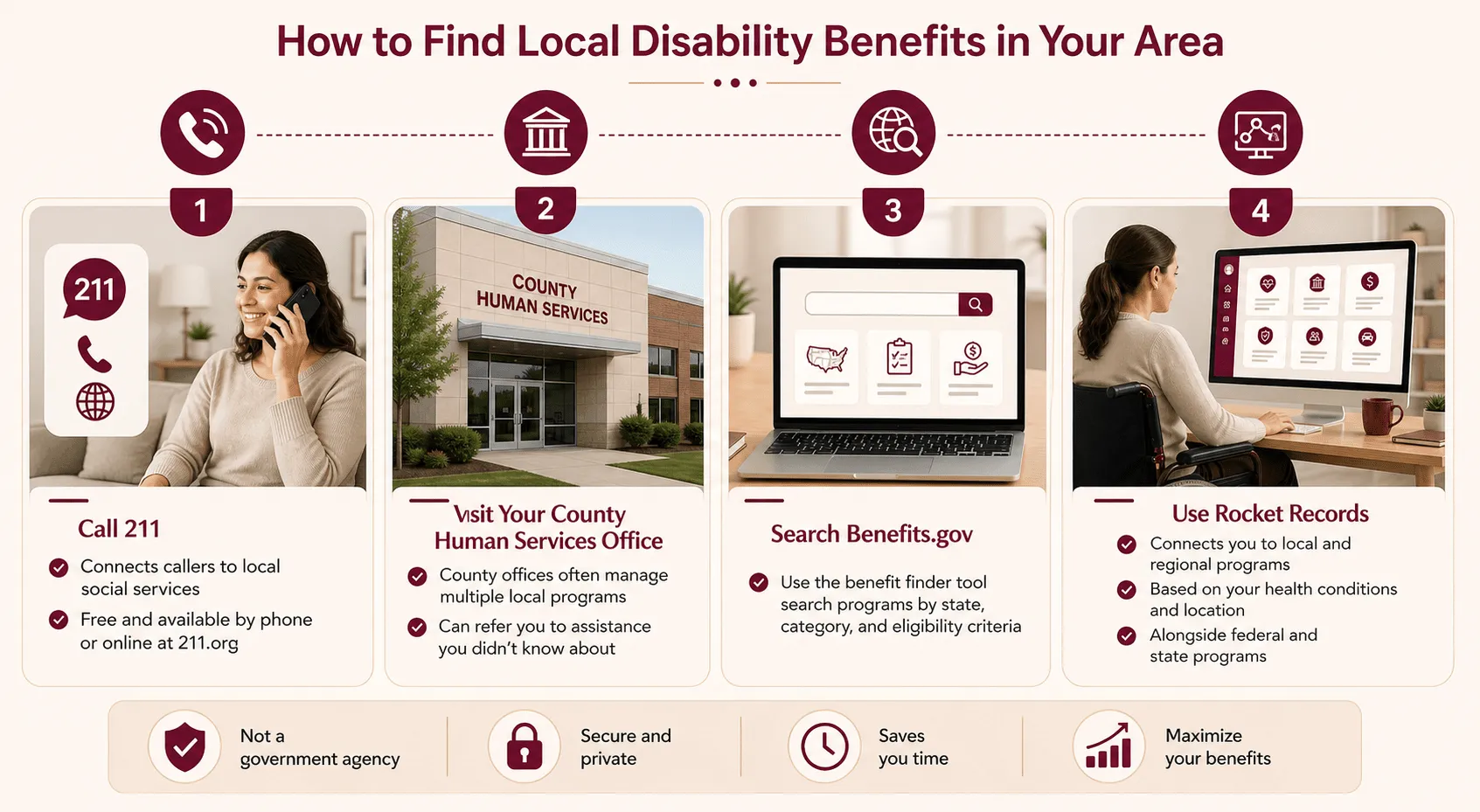
How to Find Local Disability Benefits in Your Area
Step 1: Call 211. The 211 helpline connects callers to local social services in most U.S. areas. It is free and available by phone or online at 211.org.
Step 2: Visit your county human services office. County offices often manage multiple local programs and can refer you to assistance you did not know about.
Step 3: Search Benefits.gov. Use the benefit finder tool to search programs by state, category, and eligibility criteria.
Step 4: Use Rocket Records. The platform connects users to local and regional programs based on their health conditions and location, alongside federal and state programs.
Local programs often have no income ceiling as strict as federal programs. This makes them more accessible for people who earn too much for SSI but not enough for stable living. If you were turned down for federal or state benefits, local general assistance may still be an option.
How Federal, State, and Local Benefits Interact
Here is where things get interesting and where most people make mistakes. Getting benefits from one level does not on its own rule you out from another. But some programs do reduce your payment when you receive income from a different source. Knowing which ones stack and which ones offset each other is a key part of building the right benefit bundle.
Programs That Work Together
SSDI and VA Disability Pay: These two programs do not offset each other. You can receive both at full value at the same time. For veterans with both a service-connected condition and a qualifying work history, this is one of the most valuable pairings available.
State Short-Term Disability and SSDI: You usually cannot receive both for the same disability at the same time. But state short-term disability can cover the SSDI five-month waiting period, then stop when SSDI payments begin. This makes state short-term disability one of the most practical programs for people who are applying for federal benefits.
SSI and State Extra payment: Many states add a small payment on top of the federal SSI payment. This is called state extra payment. If you receive federal SSI, you may on its own receive a state supplement without needing to apply separately. The SSA handles the management in most states.
Medicare and Medicaid: People who qualify for both are called dual eligible. This usually means SSDI recipients with low income who also qualify for state Medicaid. Dual eligible status provides broad coverage for both hospital and long-term care costs.
Programs That Can Offset Each Other
Some local cash assistance programs are reduced dollar for dollar when you receive federal SSI. This means applying for local general assistance while receiving SSI might not add to your total income. Always check the rules of your local program before applying to avoid reducing what you already receive.
Workers’ compensation and SSDI can also interact. If you receive workers’ compensation and SSDI at the same time, the combined total usually cannot exceed 80% of your pre-disability earnings. Any amount above that reduces your SSDI payment.
The Benefit Bundling Strategy
Benefit bundling means looking at all three levels at once and identifying which programs work together to give you the maximum total support. A person with a chronic condition might receive SSDI at the federal level, a state prescription savings benefit, a county transit pass, and a local utility discount, all at the same time, with no offsets between them.
This is the core of what Rocket Records does. The platform checks all three government levels at the same time and shows you which benefits complement each other. You can read more about the multiple disability benefits approach in the Rocket Records benefit bundling guide on the blog.
How Rocket Records Handles Eligibility and Benefits Verification Across All Three Levels
The eligibility and benefits verification process is one of the most time-consuming parts of accessing benefits. Checking federal programs requires navigating the SSA website. Checking state programs requires knowing what your state offers. Checking local programs requires knowing which county offices to contact. Rocket Records handles all three at the same time.
Here is how the process works on the platform. You answer a few plain-language questions about your age, health conditions, work history, and income. The AI checks your answers against the rules for more than 25 federal and state benefit programs at once. Then you see your complete benefits list on a single dashboard, with a clear explanation of each program and what it can provide.
For programs that require a physician to sign off, such as FMLA paperwork, handicap parking placards, ESA letters, and PSD letters, Rocket Records connects you with state-licensed physicians who complete the required forms within 24 to 48 hours. You do not need to schedule a separate doctor’s appointment for each form. If you are wondering how do I claim disability benefit from multiple levels at once, this is the answer: one platform, one session, all three levels.
What Rocket Records Checks at Each Government Level
| Federal Programs | State Programs | Local and Other Programs |
|---|---|---|
| SSDI | State short-term disability (CA, NY, NJ, RI, HI) | County general assistance |
| SSI | State paid family leave | Local transit passes |
| VA disability pay | State Medicaid programs | Local utility discounts |
| FMLA leave protection | State prescription assistance | County housing assistance |
| Federal prescription savings | State job support | Local food programs |
| Student loan discharge | State property tax exemptions | 211-connected local services |
| Medicare and Medicaid | State extra payment for SSI | City accessible housing lists |
The claim for continued disability benefits process is also supported through the platform. Rocket Records helps you keep your medical certifications and health records organized so that when the SSA sends a Continuing Disability Review notice, you have everything you need to respond quickly. You can review how this works in the claim for continued disability benefits guide in the Rocket Records blog.
Everything you enter into the platform is protected under HIPAA, the federal law covering the privacy of health information. Rocket Records does not share your data with employers, government agencies, or third parties without your permission.
Conclusion
Knowing who qualifies for disability benefits at the federal level is just the beginning. State and local programs add meaningful support on top of what the federal government offers, and most people never find out about them because no single guide has ever put all three levels in one place.
Federal benefits are the foundation. State programs fill the gaps. Local programs catch the people who fall through the cracks of the first two levels. Together, the three levels can provide a much stronger financial safety net than any single program on its own.
Benefit bundling across all three levels is the strategy that maximizes your total support. The eligibility and benefits verification process needs to happen at each level separately, which is exactly what Rocket Records automates. Most users discover multiple disability benefits they had no idea they qualified for, all in a single session that takes under five minutes.
Check Federal, State, and Local Benefits All at Once.
Rocket Records scans more than 25 federal, state, and local benefit programs and finds everything you qualify for in a single session. Pre-filled paperwork. State-licensed physicians. Most users see their full list in under five minutes.
Start Your Free Benefits Search at Rocket Records





 Ask ChatGPT
  Ask Claude
  Ask Perplexity