

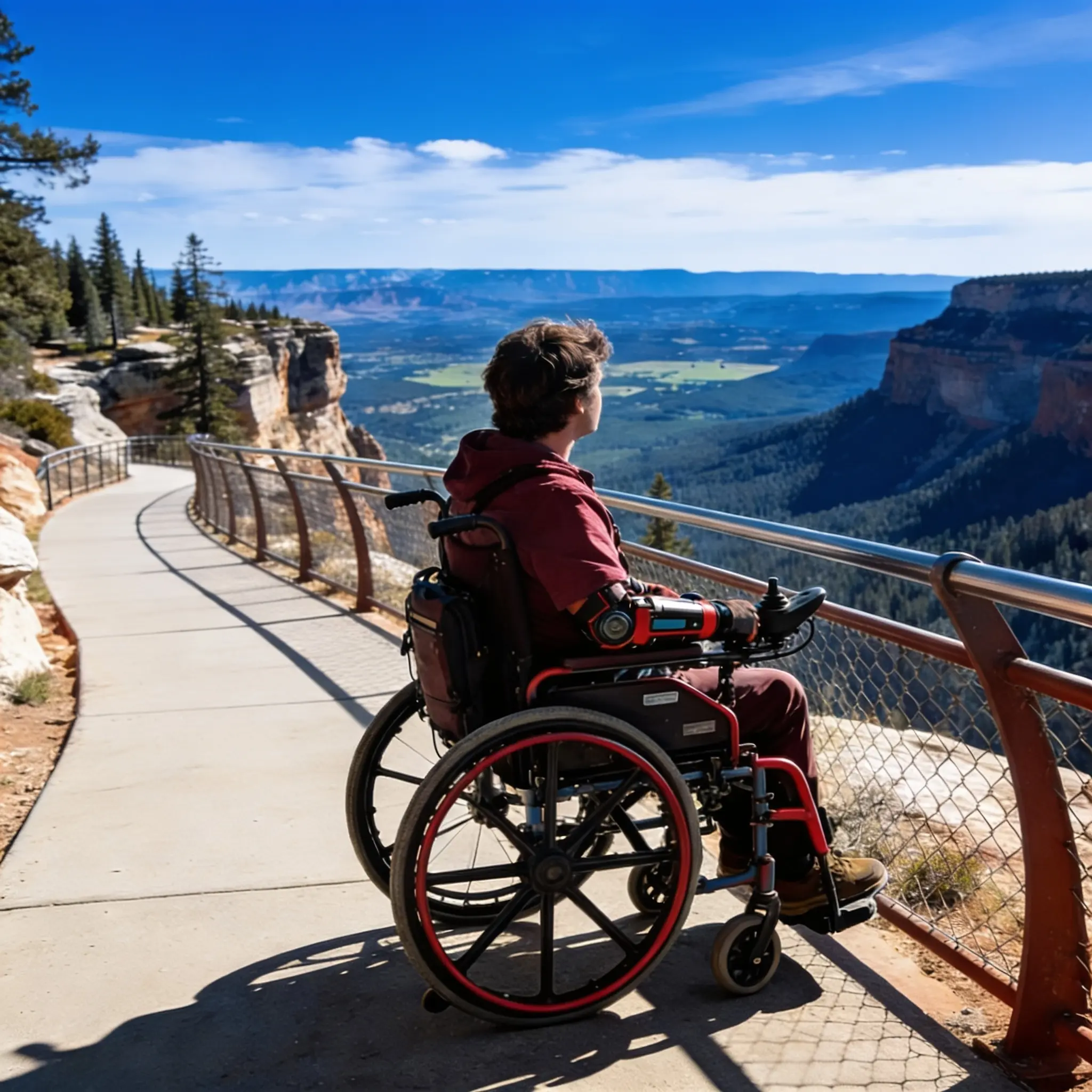

The Lifetime Access Pass gives U.S. citizens and permanent residents with permanent disabilities free entry to over 2,000 federal recreation sites. This includes national parks, forests, wildlife refuges, and recreation areas. Yet millions of eligible people never claim this benefit. Many don’t know they qualify. Others get confused by the application process.
This guide shows you precisely how to get your America the Beautiful Access Pass. You’ll learn who qualifies, what documents you need, and how to apply. We’ll also cover the full range of benefits beyond free park entry. These include discounts on camping fees and amenity passes for your vehicle passengers.
We’ll cover what you need to qualify. We’ll show you disability forms you need. You can apply in person or by mail. You’ll also learn what Rocket Records can help with and what the National Park Service handles directly. By the end, you’ll know precisely how to claim your Lifetime Access Pass and start saving money on outdoor recreation.
What Is the Lifetime Access Pass and Who Issues It
The Lifetime Access Pass is a free federal recreation pass for U.S. citizens and permanent residents with permanent disabilities. It grants lifetime entry to more than 2,000 federal recreation sites. This includes national parks, forests, wildlife refuges, and recreation areas.
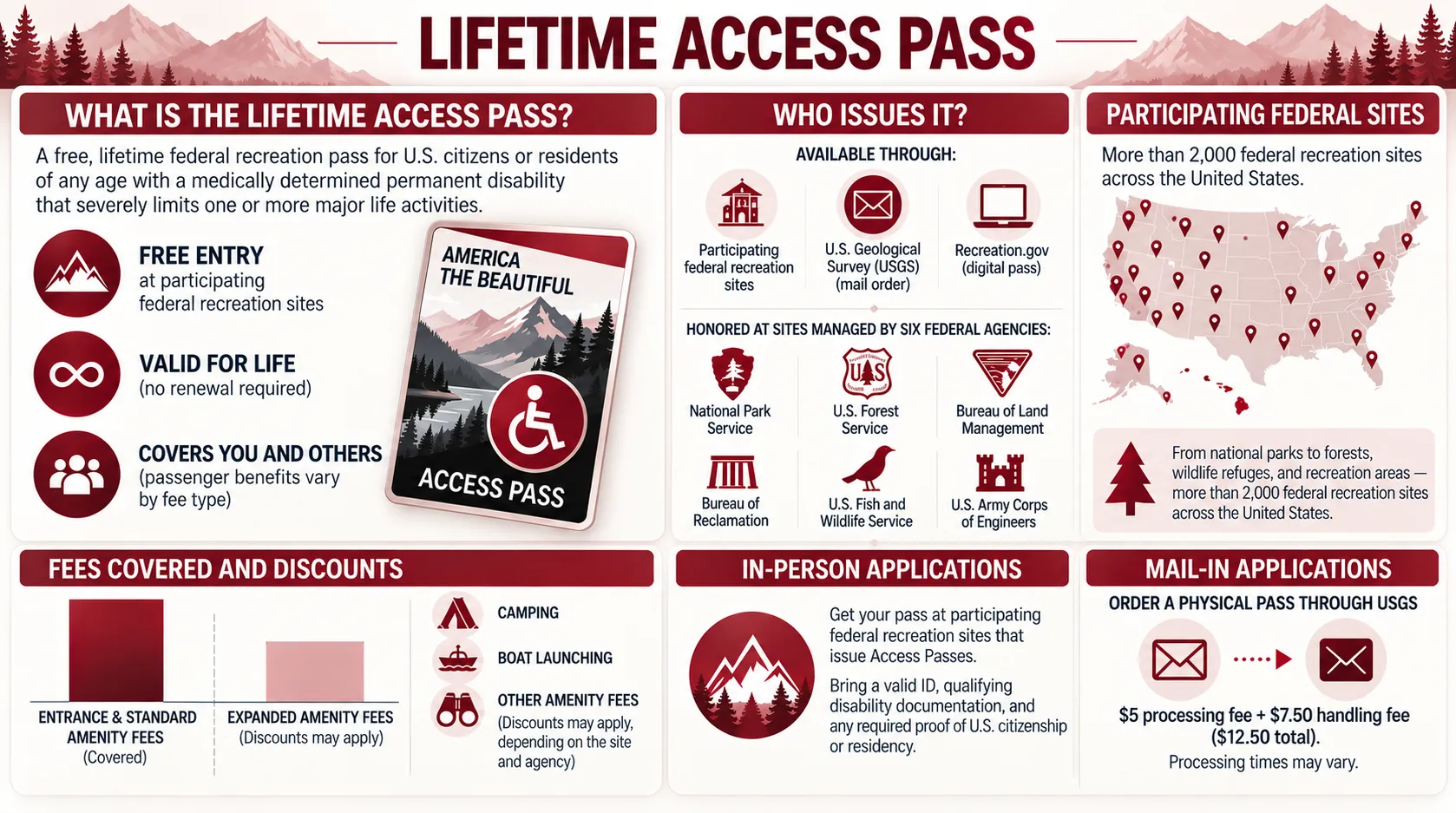
The official name is the America the Beautiful Access Pass. It replaced the Golden Access Passport, which is still valid for its holder’s lifetime. The Access Pass itself is lifetime-valid and does not require renewal.
Official Name and Federal Authority
The U.S. Geological Survey issues the pass. Multiple federal land management agencies manage it together. These agencies include the National Park Service, U.S. Forest Service, Bureau of Land Management, U.S. Fish and Wildlife Service, and Bureau of Reclamation.
According to the official America the Beautiful pass program, the pass provides free entry and discounts on amenity fees. You can get the pass in person at participating federal sites. You can also apply by mail through the U.S. Geological Survey.
Difference Between Access Pass and Other Federal Passes
The Access Pass differs from standard recreation passes in three ways. First, it is free while the 2026 Resident Annual Pass costs $80. Second, it lasts for life instead of one year. Third, it may provide discounts on certain expanded amenity fees, depending on the site and agency.
The pass also covers the pass holder plus three adults in a single vehicle. Children under 16 enter free regardless of pass type. This makes the Access Pass one of the most valuable National Park Passes available for disability benefits in the federal system.
Which Federal Agencies Accept the Pass
Six federal agencies honor the Access Pass at sites that charge applicable entrance or standard amenity fees. The National Park Service manages 423 sites, including Yellowstone, Yosemite, and the Grand Canyon. The U.S. Forest Service oversees 193 million acres of national forests and grasslands.
The Bureau of Land Management controls 245 million acres of public lands. The U.S. Fish and Wildlife Service manages the National Wildlife Refuge System. The Bureau of Reclamation operates recreation sites at federal water projects.
The pass works at any site that charges an entrance or standard amenity fee. It does not cover special permits, guided tours, or concessionaire fees. The lifetime nature of the pass means you save money every year you use it.
Primary Eligibility Requirements for the Lifetime Access Pass
The Lifetime Access Pass offers free entry to over 2,000 federal recreation sites. But not everyone qualifies. Federal agencies set three main standards for you. You must meet citizenship, disability, and documentation rules. Understanding these requirements upfront saves time and prevents application delays.
Citizenship and Residency Requirements
You must be a U.S. citizen or permanent resident to qualify for the Lifetime Access Pass. This requirement applies to all federal recreation passes. Non-citizens and temporary visa holders do not qualify, even if they have a documented disability.
According to the U.S. Geological Survey, applicants must provide identification showing U.S. citizenship or residency and documentation of permanent disability. Acceptable documents include a U.S. passport, birth certificate, or permanent resident card. The park service will deny your application without this proof. Your disability status does not change this rule.
Definition of Permanent Disability Under Federal Guidelines
For the Access Pass, a permanent disability means a lasting physical, mental, or sensory impairment. This impairment must limit one or more major life tasks. Temporary disabilities do not qualify, no matter how severe or long-lasting they may be.
Permanent disability means your condition limits major life activities and will not improve over time. Examples include mobility impairments, vision loss, chronic pain conditions, and neurological disorders. A licensed doctor must document your condition. You can also verify your condition through federal disability benefits. Social Security Disability Insurance counts as proof.
People with diabetes, heart disease, or chronic respiratory conditions may qualify. Your condition must meet the permanence standard. The key is demonstrating that your disability is ongoing and affects your daily functioning.
Age Requirements and Exceptions
No minimum or maximum age requirement exists for the Lifetime Access Pass. Children with permanent disabilities qualify for their own pass. Adults of any age can apply as long as they meet citizenship and disability criteria.
This is different from other federal programs that impose age restrictions. The Access Pass focuses solely on disability status, not age. Parents apply for passes on behalf of children with disabilities. These include developmental delays, cerebral palsy, and other permanent conditions. Doctors diagnose these conditions early in the child’s life.
If you need help determining your eligibility or completing the application process, services like the Disabled Discount Pass Application can guide you through documentation requirements and submission steps. The application process is straightforward once you have the right paperwork in order.
What Types of Disabilities May Qualify for the Access Pass?
The America the Beautiful Access Pass is available to U.S. citizens and permanent residents with permanent disabilities. However, not all health conditions automatically qualify. The National Park Service bases eligibility on functional limitations, not just a diagnosis. Your condition must affect major life tasks. These tasks include walking, seeing, hearing, or self-care.
Understanding which health conditions meet federal disability standards helps you determine if you qualify. The pass is free and provides lifetime access to over 2,000 federal recreation sites. It also offers a 50% discount on amenity fees like camping and boat launches.
Understanding Functional Limitations and Permanent Disability
Eligibility centers on permanent disability status. Your condition will last for your whole life. Temporary injuries or short-term illnesses do not qualify. The disability must create functional limitations that affect your daily life in measurable ways.
Functional limitations refer to how your condition restricts major life activities. These include walking, standing, lifting, bending, seeing, hearing, speaking, breathing, learning, and working. Your disability must severely limit one or more major life activities to meet the Access Pass standard.
You do not need a Social Security disability determination to qualify. However, having one strengthens your application. A licensed physician can write a statement for you. You can show proof of getting disability benefits. A state rehab agency can verify your status.
Physical and Sensory Impairments That May Qualify
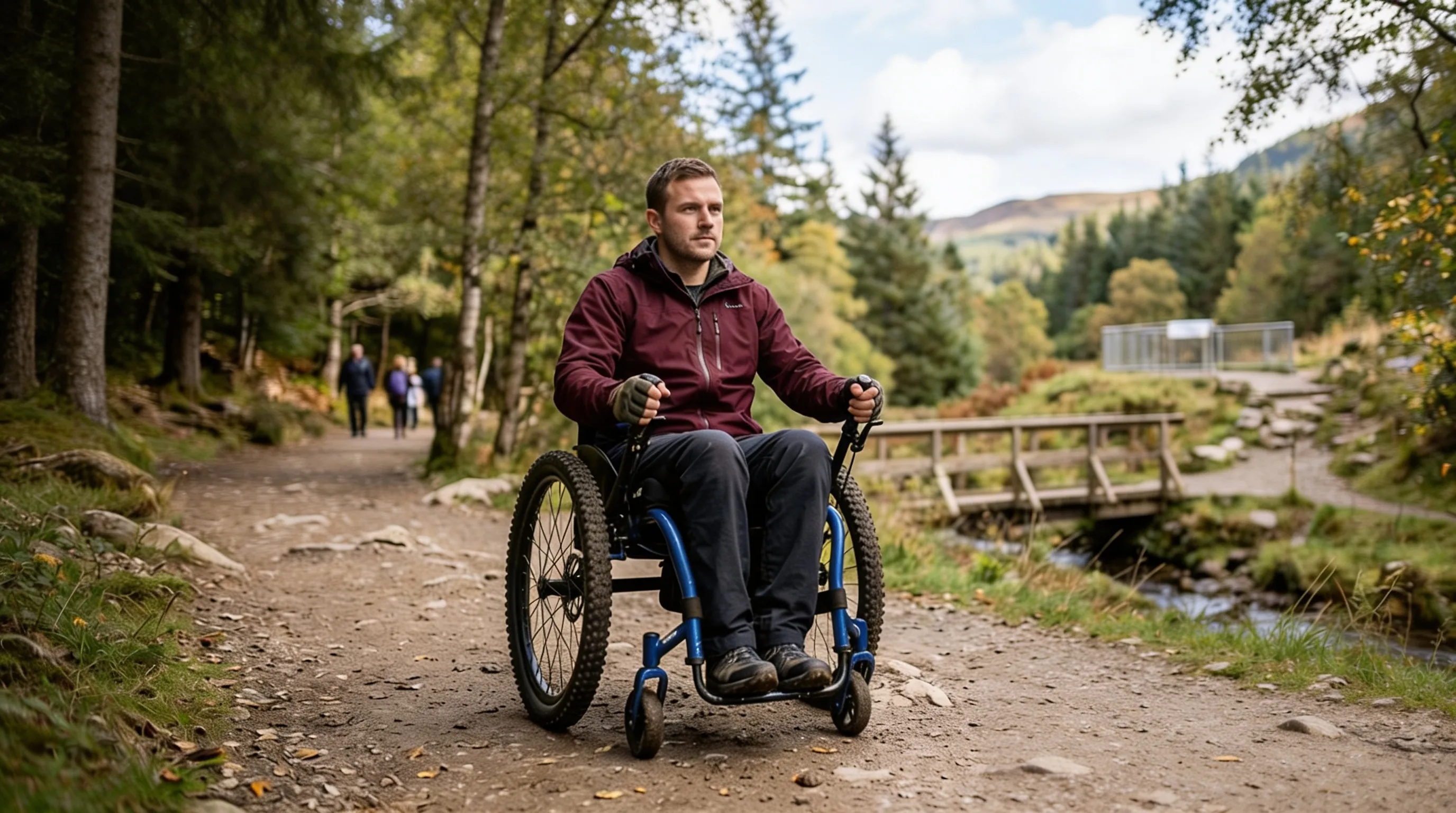
Mobility impairments are among the most common qualifying conditions. Paralysis, amputation, and severe arthritis count as qualifying conditions. Conditions that make walking or standing hard also count. Using a wheelchair, walker, or cane does not automatically establish eligibility. Your permanent disability must severely limit one or more major life activities.
Vision impairments also qualify when they create permanent functional limitations. Legal blindness is a clear qualifier. Severe vision loss that affects your ability to navigate safely or perform daily tasks also meets the standard. Conditions like macular degeneration, diabetic retinopathy, and glaucoma may qualify based on severity.
Hearing impairments qualify when they are permanent and affect communication. Deafness and severe hearing loss both meet the criteria. You may qualify if you rely on hearing aids, cochlear implants, or sign language to communicate effectively.
Chronic Conditions and Their Impact on Eligibility
Chronic conditions qualify when they create permanent functional limitations. Diabetes with complications like neuropathy, retinopathy, or kidney disease often meets this standard. Heart disease that limits physical activity or causes chronic fatigue may also qualify.
Severe COPD, cystic fibrosis, and chronic asthma can qualify. These conditions must limit breathing or physical exertion. If your condition prevents you from walking long distances or climbing stairs, you likely meet the criteria.
Neurological conditions including multiple sclerosis, Parkinson’s disease, and epilepsy qualify based on their impact on movement, balance, and daily functioning. Mental health conditions like severe depression, PTSD, and schizophrenia may qualify. You must have proof that your condition is permanent. They must limit major life activities.
Cognitive disabilities including intellectual disabilities and traumatic brain injury qualify based on functional impact. If your condition affects learning, memory, decision-making, or self-care, you may be eligible. Platforms like Rocket Records help you identify which benefits you qualify for based on your specific health status. The benefit verification process matches your condition to available programs in minutes, showing you exactly what documentation you need to apply.
Documentation Required to Prove Disability Eligibility
Getting your Lifetime Access Pass starts with the right paperwork. You need proof that shows your disability is permanent. The National Park Service accepts several types of documentation, but not all medical records qualify.
Your documents must clearly state your condition is permanent, not temporary. This is the most common reason applications get rejected. Let’s break down what works and what doesn’t.
Acceptable Forms of Medical Documentation
A signed statement from a licensed physician can document your eligibility if it confirms that the disability is permanent, severely limits one or more aspects of daily life, and describes those limitations. The letter must certify your permanent disability and explain how it limits your mobility or daily activities. Generic medical records without this certification won’t work.
The physician’s statement should include your diagnosis, how long you’ve had the condition, and why it’s considered permanent. State vocational rehabilitation agencies can also provide certification of permanent disability. This option works well if you’re already working with a state agency for employment support.
Medical records alone are not sufficient. You need a doctor’s explicit certification that ties your condition to permanent disability status. This distinction trips up many applicants who submit test results or treatment histories without the required physician statement.
Social Security Disability Determination Letters
Social Security Disability Insurance (SSDI) award letters are among the strongest forms of proof. These letters show you got federal disability benefits. They show the Social Security Administration has already determined your condition meets their strict disability criteria.
Supplemental Security Income (SSI) documentation also qualifies. Both programs require extensive medical evidence and functional assessments. If you have either letter, your Access Pass application will move quickly.
Benefit verification letters from Social Security work too. You can request these online through your My Social Security account. They serve as official proof of your disability status without needing to submit your original award letter.
Veterans Affairs Disability Documentation
You can use federal agency papers to prove permanent disability. The Department of Veterans Affairs papers work for this. These papers help you get an Access Pass. You need documentation showing your disability rating from the Department of Veterans Affairs.
The VA assigns disability ratings from 0% to 100% based on the severity of your service-connected condition. VA documentation can establish eligibility when it meets the federal documentation requirements for a permanent disability. Your VA benefits letter or disability rating decision letter both work as proof.
Veterans can obtain these documents through the VA’s eBenefits portal or by contacting their regional VA office. The process is faster than getting new medical documentation since the VA has already evaluated your disability status. This makes it one of the easiest paths for eligible veterans.
What Rocket Records Does Not Issue
Rocket Records does not issue the Lifetime Access Pass itself. The National Park Service or the appropriate federal recreation agency issues the Access Pass. Rocket Records does not have the authority to issue federal recreation passes of any kind.
Understanding the Role of Federal Agencies
The U.S. Geological Survey manages the official Access Pass program. Only federal agencies can issue this pass. Rocket Records operates as a documentation support service, not a federal issuing authority.
You must get your Access Pass from federal recreation sites. You can also request it by mail through the USGS. No private company can issue this pass on behalf of the government.
How Rocket Records Supports Your Application
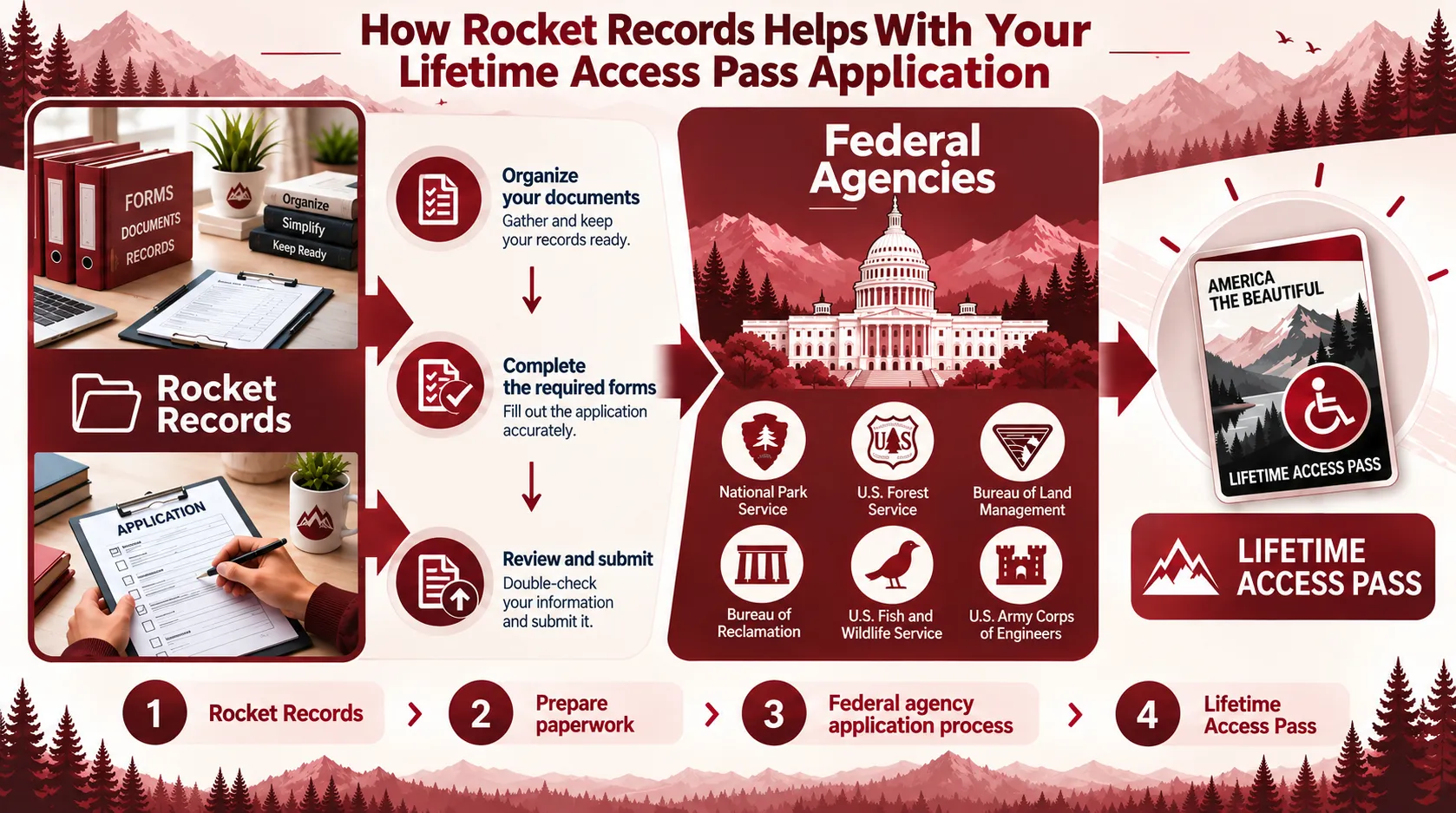
Rocket Records helps users identify eligibility for the Access Pass based on their health conditions. The platform assists with gathering and organizing medical documentation required for the application. This includes preparing physician certification forms.
The service connects users with licensed healthcare providers who can complete required paperwork. Understanding how the documentation process works helps you prepare everything correctly before submitting to federal agencies. Rocket Records streamlines the paperwork but does not replace the official federal application pathway.
You still need to submit your completed application to the appropriate federal agency. The platform prepares everything you need for that submission. This saves time and reduces errors in your application.
The Difference Between Documentation and Issuance
Documentation means gathering proof of your disability status. Issuance means receiving the actual pass from a federal agency. Rocket Records handles the first part, not the second.
The platform prepares your medical certification forms and supporting documents. You then submit these materials to the USGS or visit a federal recreation site. The federal agency reviews your application and issues the pass if you qualify.
This separation protects the integrity of federal programs. Only authorized government agencies can issue official federal recreation passes. Rocket Records helps you get ready for that process with complete, accurate documentation.
How to Apply for Your Lifetime Access Pass
Getting your Lifetime Access Pass is simple. You can apply in person or by mail. Both methods work well. Choose the one that fits your schedule.
In-Person Application at Federal Recreation Sites
The fastest way to get your pass is in person. Visit any participating federal recreation site during operating hours. This includes national parks, forests, and wildlife refuges.
Bring three items with you. You need a valid photo ID. You also need proof of citizenship or residency. Finally, bring documentation of your permanent disability.
You can obtain the pass during your visit at participating locations that issue Access Passes. The pass itself is free, with no processing fee for in-person issuance.
Staff at the site will take your photo. You’ll sign the pass on the spot. The whole process takes about 15 minutes.
Mail Application Process and Required Forms
If you can’t visit a site in person, you can order an Access Pass through the U.S. Geological Survey by submitting the required documentation and paying the $5 processing fee and $7.50 handling fee. Download it from their website or request one by phone.
Include copies of your required documentation. Send your photo ID copy. Add proof of citizenship or residency. Include your disability documentation.
USGS mail orders currently require a $5 processing fee and a $7.50 handling fee, for a total of $12.50. Make your check or money order payable to USGS.
Send everything to the U.S. Geological Survey Store in Denver, Colorado. The application form shows the address. Use certified mail if you want delivery confirmation.
Processing Time and Pass Delivery
Mail applications take longer than in-person visits. Processing time is typically 3-4 weeks from the date they receive your application.
Your pass arrives as a plastic card. It looks similar to a credit card. Your photo and signature appear on the front.
The card is durable and wallet-sized. Keep it with you when visiting federal recreation sites. Show it at entrance stations for free admission.
If your application is incomplete, USGS will contact you. They’ll tell you what’s missing. Fix the issue and resubmit. This adds time to the process.
Benefits Included with the Lifetime Access Pass
The Lifetime Access Pass offers three major benefit categories. Each one saves you money and makes visiting federal recreation sites easier. Here’s what you get when you hold this pass.
Free Entry to Federal Recreation Sites
The pass grants free entrance to all national parks, monuments, historic sites, and recreation areas that charge entrance fees. This covers more than 2,000 federal recreation sites across the country. You won’t pay entrance fees at any location that participates in the program.
The pass works at iconic destinations like Yellowstone, Yosemite, and the Grand Canyon. It also covers lesser-known sites like national wildlife refuges and Bureau of Land Management recreation areas. If a federal site charges an entrance fee, your pass gets you in free.
This benefit alone can save families hundreds of dollars per year. The standard entrance fee at popular parks ranges from $15 to $35 per vehicle. If you visit just five parks annually, you save $75 to $175 in entrance fees.
Discount on Expanded Amenity Fees
Beyond free entrance, the pass provides a 50% discount on expanded amenity fees at participating sites. These fees cover services and facilities that go beyond basic entrance. According to the U.S. Forest Service, discounts apply to camping, swimming, boat launching, and specialized interpretive services.
The discount does not apply to concession-operated facilities like lodges, restaurants, or gift shops. It also excludes special recreation permits and reservation fees. However, the 50% savings on camping alone can add up quickly for frequent visitors.
For example, a campsite that normally costs $30 per night drops to $15 with the pass. Over a week-long camping trip, that’s $105 in savings. Check the site’s current fee rules before planning your trip. Boat launch fees, guided tours, and other amenity charges also get cut in half.
Passholder, Vehicle, and Passenger Benefits
The pass covers different numbers of people depending on how the site charges fees. At per-vehicle fee areas, the pass admits the passholder and all passengers in a single private non-commercial vehicle. This means your entire family or group rides in free together.
At per-person fee areas, the pass admits the passholder plus three adults age 16 and older. Children under 16 are always admitted free when accompanying the passholder, regardless of pass status. This structure makes the pass valuable for families with teenagers or groups of adults.
You cannot give the pass to anyone else. You must show a photo ID when you use it. You can’t lend it to friends or family members. Coverage varies by site fee structure, so verify specific benefits at each location you visit before arriving.
Some sites charge per vehicle while others charge per person. Knowing which structure applies helps you plan group visits and maximize your savings. The pass works best when you travel with multiple adults or visit per-vehicle fee areas frequently.
Conclusion
The Lifetime Access Pass opens doors to over 2,000 federal recreation sites. You get free entry plus 50% off camping and amenity fees. All you need is proof of permanent disability and U.S. citizenship or permanent residency.
You can apply in person at any participating federal site for free. Or order a physical pass through USGS with $5 in processing fees and $7.50 in handling fees. Both options work well. Bring your medical documentation from a licensed physician, Social Security, Veterans Affairs, or a state vocational rehabilitation agency.
This national park disability pass saves you money every time you visit. The benefits add up fast when you explore federal lands across the year. Your pass never expires.
Start your application today if you meet the eligibility requirements. Visit a nearby national park or federal recreation site with your documentation. You can also download the mail application form from the U.S. Geological Survey website. For help identifying all benefits you qualify for based on your health conditions, complete a free eligibility assessment at Rocket Records in under five minutes.





 Ask ChatGPT
 Ask Claude
 Ask Perplexity