

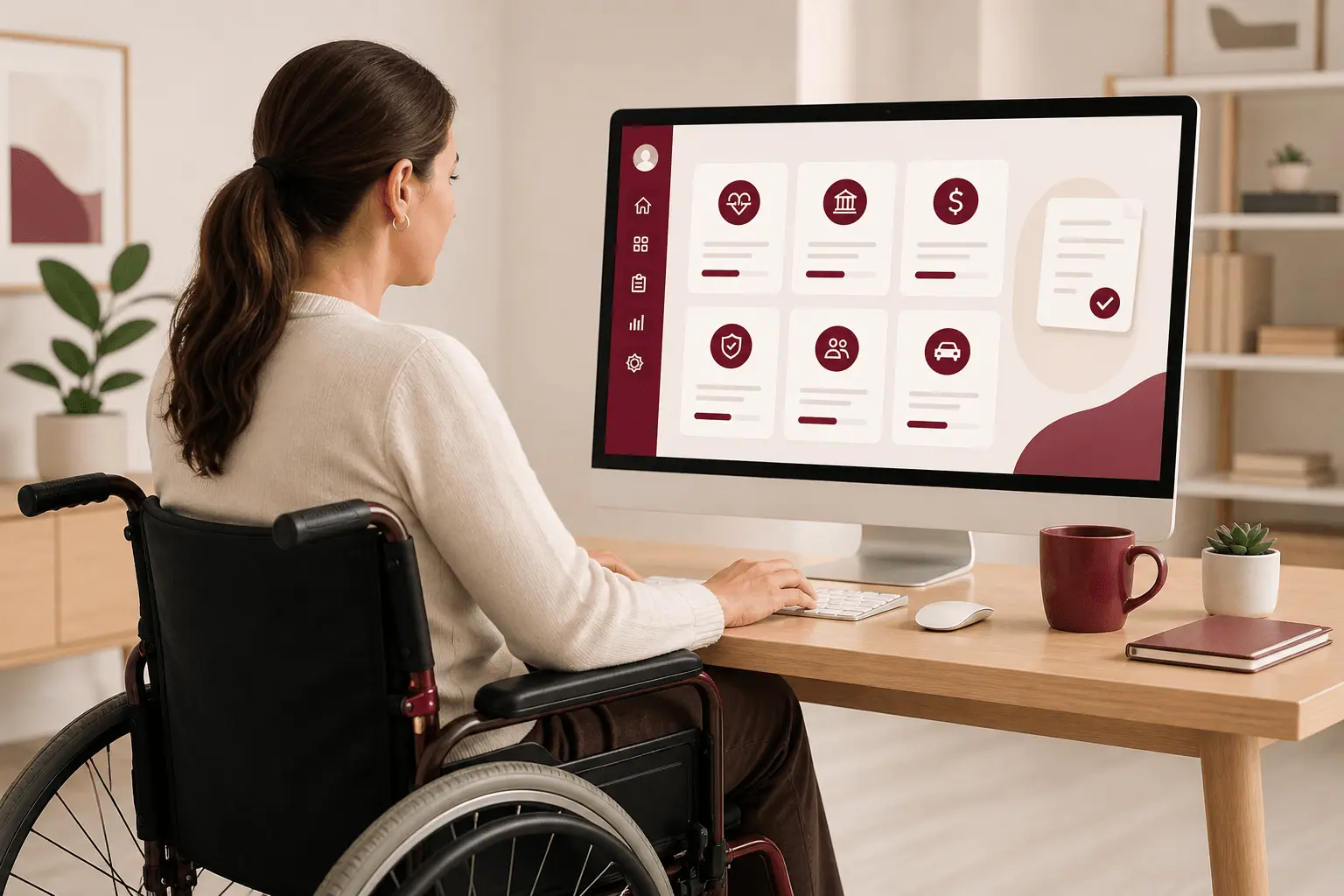
Do I actually qualify for disability benefits? That is one of the most common questions people search for, and it is one of the hardest to get a straight answer on. Most guides give you general rules. This one gives you a plain-language breakdown based on your age, your health, and your work history.
The process of eligibility and benefits verification has two parts. The first part is whether you meet the program rules, which includes your age, your income, and your work history. The second part is whether your health condition meets the medical standard the SSA uses to define disability. Most people only look at one part and miss the other.
This guide answers who qualifies for disability benefits clearly and directly. It breaks eligibility down by age group, explains the condition categories the SSA recognizes, covers the income and work rules, and shows you how Rocket Records verifies your eligibility across more than 25 programs at once in under five minutes.
And here is something worth knowing upfront: most people who assume they do not qualify actually do qualify for at least some programs. The rules are more flexible than most guides make them seem.
What Eligibility and Benefits Verification Actually Means
Before we get into the specifics, it helps to understand what these two words actually mean. According to the SSA’s disability eligibility, eligibility means meeting the set of rules a program has for who can receive it. Verification means proving that you meet those rules with supporting evidence.
Every disability benefit program has its own set of eligibility rules. SSDI has different rules than SSI. A handicap parking placard has different rules than a prescription savings program. What they all share is that two-part structure: program rules and medical evidence.
The Two Parts of Every Eligibility Check
Part 1: Program Rules These are the non-medical requirements. They include your age, your work history, your monthly income, and your household assets. Different programs have different thresholds for each of these.
Part 2: Medical Standard This is where your health condition comes in. The SSA looks at how your condition affects your ability to work, not just what your diagnosis is. A condition that limits your ability to work for at least 12 months is the key test.
Here is the thing most people get wrong: they only check one part. They either focus on whether their condition sounds serious enough, or they focus on whether they have worked long enough. The full picture requires both. That is why USA.gov’s disability benefits overview recommends checking both the medical and non-medical requirements before applying.
Rocket Records checks both parts automatically. When you answer the health questions on the platform, the AI is looking at your age, your work history, your income, and your conditions all at the same time, across every program it has access to.
Most users who start by checking SSDI eligibility end up finding five to ten other programs they also qualify for. You can start that check at MyRocketRecords.com.
Who Qualifies by Age: A Plain-Language Breakdown
Age plays a big role in who qualifies for disability benefits and under which program. Here is how the rules work for each age group, based on data from the SSA’s 2026 eligibility requirements.
Eligibility at a Glance by Age Group
| Age Group | SSDI | SSI | Key Notes |
|---|---|---|---|
| Under 18 | Not eligible (use parent’s record) | Yes, if family has low income | Reviewed under adult rules at age 18 |
| 18 to 23 | Yes, with fewer credits needed | Yes, based on income and condition | DAC benefit available if disability began before age 22 |
| 24 to 49 | Yes, standard 20/40 credit rule | Yes, if income and assets qualify | Largest group of SSDI applicants |
| 50 to 64 | Yes, more favorable Grid Rules | Yes, if income and assets qualify | Age 55+ gets even more favorable treatment |
| 65 and over | Converts to retirement benefits | Yes, for low-income seniors | Many extra programs available beyond SSDI |
Under Age 18: Children and Disability Benefits
Children do not qualify for SSDI on their own record because they have not built a work history. But a child with a serious disability may qualify for SSI if the family has limited income and assets. The SSA looks at how the child’s condition limits their daily activities compared to other children the same age.
Children of a parent who receives SSDI may also qualify for dependent benefits on the parent’s record. These are paid directly to the child and can continue until age 18, or 19 if the child is still in school full time.
Ages 18 to 23: Young Adults
Young workers need fewer work credits to qualify for SSDI than older workers do. If you are under 24, you may need as few as 6 credits, which is about 18 months of work. This makes SSDI more accessible for young adults who became disabled early in their working life.
SSI is also a strong option for this age group because it does not require any work history at all. If your income and assets are below the program limits, and your condition meets the medical standard, you can qualify for SSI even if you have never worked.
Disabled Adult Child (DAC) benefit: If your disability began before age 22 and one of your parents receives Social Security, you may be able to collect benefits on their record. This applies even if you have never worked a day in your life. In February 2026, this program supported roughly 1 million people beyond the standard SSDI beneficiary pool.
Ages 24 to 49: Working-Age Adults
This is the largest group of SSDI applicants. The standard rule for this age range is the 20/40 rule: you need 40 total work credits, with at least 20 earned in the past 10 years. In 2026, you earn one credit for every $1,890 in wages or self-employment income, up to four credits per year.
If your income is below the SSI limits ($994 per month for individuals in 2026) and your assets are below $2,000, you can also apply for SSI at the same time as SSDI. The SSA will evaluate both and tell you which one you qualify for, or whether you qualify for both.
Ages 50 to 64: Near-Retirement Adults
The SSA’s rules become more favorable once you turn 50. The SSA has a set of guidelines called the Medical-Vocational Grid Rules that give more weight to your age when deciding if you can still work. If you are 50 or older and cannot go back to the kind of work you used to do, your chances of approval go up.
At age 55, the rules shift again in your favor. A 55-year-old with a serious physical condition who cannot do their past work has a much better chance of approval than a 35-year-old with the same condition. This group also often qualifies for prescription savings programs and other benefits that younger applicants may not be eligible for.
Age 65 and Over: Seniors
Most people who have been receiving SSDI will automatically switch to Social Security retirement benefits when they reach full retirement age. This does not mean benefits stop. It just means the payment comes from a different fund.
Seniors who do not have SSDI can still qualify for SSI if their income and assets are low enough. SSI for seniors does not require any disability at all. If you are 65 or older with limited income, you may qualify regardless of your health.
Seniors are also the group most likely to be missing out on other programs. Prescription savings, utility discounts, tax credits, and free park passes are all available to many older adults who simply never heard about them.
Who Qualifies by Condition: Health Requirements in Plain Language
The SSA does not say yes or no based on your diagnosis name alone. What matters is how your condition affects your ability to work every day. The full list of recognized conditions is in the SSA Blue Book, but even conditions not on that list can qualify through other review paths.
Your condition must limit your ability to work for at least 12 months in a row. It must also keep your earnings below the monthly limit the SSA calls Substantial Gainful Activity (SGA). In 2026, SGA is $1,690 per month for most people, and $2,830 per month for those who are blind.
Condition Categories and How the SSA Evaluates Them
| Condition Type | SSA Evaluation Path | Common Examples |
|---|---|---|
| Physical conditions | Blue Book listing or RFC review | Back problems, heart disease, cancer, COPD, diabetes complications |
| Mental health conditions | Blue Book listing (Section 12.00) | Depression, anxiety, PTSD, bipolar disorder, schizophrenia |
| Conditions not in the Blue Book | RFC (Residual Functional Capacity) review | Fibromyalgia, chronic fatigue, long COVID, chronic migraines |
| Fast-track conditions | Compassionate Allowances (300 conditions) | ALS, acute leukemia, pancreatic cancer, early-onset Alzheimer’s |
Physical Conditions
Back and joint problems make up about 34% of all approved SSDI claims. But physical conditions cover a wide range beyond back pain. Heart disease, breathing problems, cancer, nerve damage from diabetes, and vision loss all qualify under specific sections of the SSA Blue Book.
What the SSA wants to see for physical conditions is medical evidence: X-rays, lab results, imaging scans, and detailed records from your treating physician. The more specific your records are about what you can and cannot do, the stronger your claim will be.
Mental Health Conditions
Mental health is the leading reason SSI is approved. About 60% of SSI adults under age 65 have a mental health diagnosis. Depression, anxiety, PTSD, and bipolar disorder all qualify under SSA Blue Book Section 12.00 when they are severe enough to limit your ability to work on a daily basis.
The SSA looks at four areas of function for mental health claims: learning and memory, getting along with others, staying focused and keeping pace, and managing the demands of daily life. You need a very severe limit in one of these areas, or a serious limit in two, to meet the standard.
Conditions Not in the Blue Book
This is where many people give up too soon. If your condition does not have an exact match in the SSA Blue Book, you can still qualify through the RFC review. RFC stands for Residual Functional Capacity. It means the SSA looks at what you can still do and asks whether any real job exists that you could handle.
Conditions like fibromyalgia, chronic fatigue syndrome, long COVID, and chronic migraine disorders qualify through this path all the time. The key is having strong, consistent medical records that show how your condition limits your daily work-related tasks.
Fast-Track Conditions: Compassionate Allowances
If your condition is on the SSA’s Compassionate Allowances list, you may be approved in days rather than months. As of 2025, there are 300 conditions on this list. They include ALS, acute leukemia, pancreatic cancer, early-onset Alzheimer’s disease, and many rare disorders. The SSA screens for these automatically when you apply.
Work History and Income: The Other Side of Eligibility
The medical side of eligibility gets most of the attention. But the program rules around work history and income are just as important, and they trip up a lot of applicants. Here is how they work, based on the SSA’s 2026 Red Book.
Work Credits for SSDI
SSDI is an earned benefit. You qualify by working and paying Social Security taxes over time. The SSA measures this through work credits. In 2026, you earn one credit for every $1,890 in wages or self-employment income, up to four credits per year.
Most adults need 40 total credits to qualify for SSDI, with at least 20 of those earned in the past 10 years. This is called the 20/40 rule. But younger workers need fewer credits. If you are under 24, you may qualify with just 6 credits.
SSDI vs. SSI: Key Eligibility Differences
| SSDI | SSI |
|---|---|
| Requires a work history and credits | No work history required |
| No income or asset limit (above SGA level) | Income limit: $994/month individual (2026) |
| No asset limit | Asset limit: $2,000 individual, $3,000 couple |
| Available from age 18 to full retirement age | Available at any age, including children and seniors |
| Leads to Medicare after 24 months | Leads to Medicaid in most states right away |
| Average monthly benefit: $1,537 in 2026 | Maximum monthly benefit: $994 in 2026 |
SSI Income and Asset Rules
SSI is a needs-based program. It does not care how much you worked. What it cares about is how much money you have coming in and how much you own. In 2026, the income limit for an individual is $994 per month. The asset limit is $2,000 for a single person and $3,000 for a couple.
Your home and one car do not count toward the asset limit. And not all income counts either. The SSA leaves out the first $65 of earned income each month, plus half of any earnings above that. This means you can earn a small amount of income and still qualify for SSI.
The SGA Limit and Working While Applying
If you are working while you apply, your earnings must be below the SGA limit. In 2026, that is $1,690 per month for most people and $2,830 for those who are blind. Earning above this amount means the SSA will generally find you are not disabled, regardless of your medical condition.
You can still apply for SSDI if you are working below the SGA limit. And if you are not working at all, the SGA rule does not come into play at the first step. The SSA will simply move on to reviewing your medical condition.
Not Sure If You Qualify? Check in Under 5 Minutes.
Answer a few plain-language questions about your health, age, and work history and Rocket Records’ AI will verify your eligibility across more than 25 federal and state benefit programs at once. No paperwork. No phone calls. No guessing.
Check Your Eligibility Free at Rocket Records
Can Family Members Qualify? Benefits for Dependents and Caregivers
Eligibility is not only for the person with the disability. When a worker is approved for SSDI, several family members may also qualify to receive benefits on the same record. This is one of the most overlooked parts of the system.
Spouse age 62 or older: A spouse who is at least 62 can receive up to 50% of the SSDI beneficiary’s monthly payment.
Spouse of any age caring for a child: If a spouse is caring for the disabled worker’s child who is under 16 or who has a disability, that spouse can also receive benefits regardless of their age.
Unmarried children under 18: Children up to age 18 (or 19 if still in high school) can receive dependent benefits on a disabled parent’s SSDI record.
Disabled Adult Child (DAC): An adult child whose disability began before age 22 can claim benefits on a parent’s Social Security record even if they have never worked. The parent must be receiving SSDI, retirement benefits, or be deceased. In 2026, the DAC benefit can be up to 50% of the parent’s monthly benefit amount.
Caregivers and FMLA: If you are caring for a family member with a serious health condition, you may qualify for job-protected leave under the Family and Medical Leave Act (FMLA). A state-licensed physician completes the required certification, and your employer cannot fire you for taking this leave.
ESA and PSD letters: Family members with mental health conditions who need an emotional support animal or a psychiatric service dog can qualify for housing and travel protections. Rocket Records connects these individuals with state-licensed physicians who complete the required letters within 24 to 48 hours.
Family eligibility is one of the areas Rocket Records checks automatically. When you answer the health questions on the platform, the AI also looks at family-related programs that may apply to your household.
How Rocket Records Handles Eligibility and Benefits Verification
Rocket Records is not a government agency. It does not approve or deny your benefits. What it does is automate the eligibility check and application process so you do not have to research 25 programs across 15 government websites on your own.
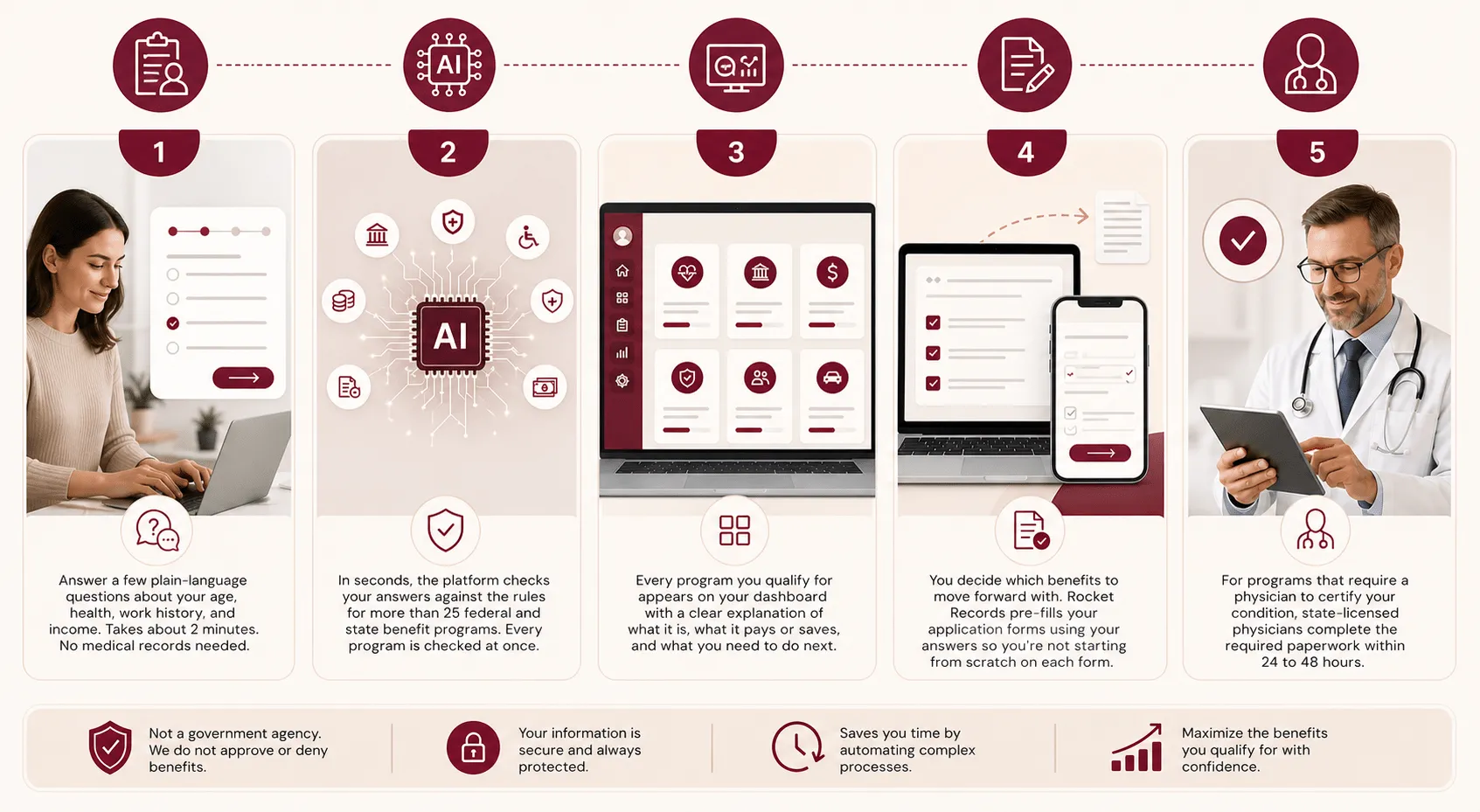
Here is how the eligibility and benefits verification process works on the platform, step by step.
-
Answer the health questions. You answer a few plain-language questions about your age, your health conditions, your work history, and your current income. This takes about two minutes. No medical records are needed to start.
-
The AI runs the eligibility check. In seconds, the platform checks your answers against the rules for more than 25 federal and state benefit programs. Every program is checked at once, not one at a time.
-
You see your personal benefits list. Every program you qualify for appears on your dashboard with a clear explanation of what it is, what it pays or saves, and what you need to do next to apply.
-
Choose your programs and apply. You decide which benefits to move forward with. Rocket Records pre-fills your application forms using the answers you already provided, so you are not starting from scratch on each form.
-
Licensed physicians handle your medical forms. For programs that require a physician to certify your condition, such as FMLA, handicap placards, ESA letters, and PSD letters, Rocket Records connects you with state-licensed physicians who complete the required paperwork within 24 to 48 hours.
What Rocket Records Checks for You
| Program | Who It Is For | Value |
|---|---|---|
| SSDI | Workers with disability and work history | Avg. $1,537/month in 2026 |
| SSI | Low-income adults and children | Up to $994/month in 2026 |
| VA Disability Pay | Veterans with service conditions | Based on rating |
| FMLA Leave | Workers needing medical leave | Job protection while in treatment |
| Handicap Parking Placard | Mobility or chronic conditions | $300 to $500/yr in value |
| Prescription Help | Chronic conditions, limited income | $1,200 to $4,000/yr |
| Disability Tax Credits | Working-age adults with disability | $3,750 to $7,500 |
| ESA or PSD Letter | Mental health conditions | Housing and travel access |
| Utility Discounts | Disability or low income | $200 to $400/yr |
| Student Loan Discharge | Total and permanent disability | Full loan balance |
| National Park Pass | Permanent disability | $80 value, free |
| State Short-Term Disability | Workers in CA, NY, NJ, RI, HI | Partial income replacement |
Everything you enter into the platform is protected under HIPAA, the federal law that covers the privacy of your health information. Rocket Records does not share your data with employers, government agencies, or third parties without your permission.
If you have questions before getting started, the Rocket Records covers how the platform works, what programs are included, and what the money-back guarantee covers.
Conclusion
The rules around eligibility and benefits verification are more flexible than most people expect. Age, work history, income, and health condition all play a role. But the key point is this: most people who think they do not qualify actually do qualify for at least some programs.
The biggest risk is not applying at all. Every month you wait is a month of potential benefits you are not receiving. And with more than 25 programs available beyond SSDI and SSI, the question is rarely whether you qualify for anything. It is usually about how many programs you qualify for that you have not yet found.
Rocket Records makes the benefits verification process fast, simple, and complete. You answer a few questions. The AI checks every program. You see your full list in under five minutes. And who qualifies for disability benefits gets a clear, specific answer rather than a vague general rule.
Verify Your Eligibility Across 25+ Programs in Under 5 Minutes.
Rocket Records checks your age, health, work history, and income against more than 25 federal and state benefit programs and tells you exactly what you qualify for. State-licensed physicians handle your medical forms. Pre-filled forms. No commitment. No risk.





 Ask ChatGPT
  Ask Claude
  Ask Perplexity