

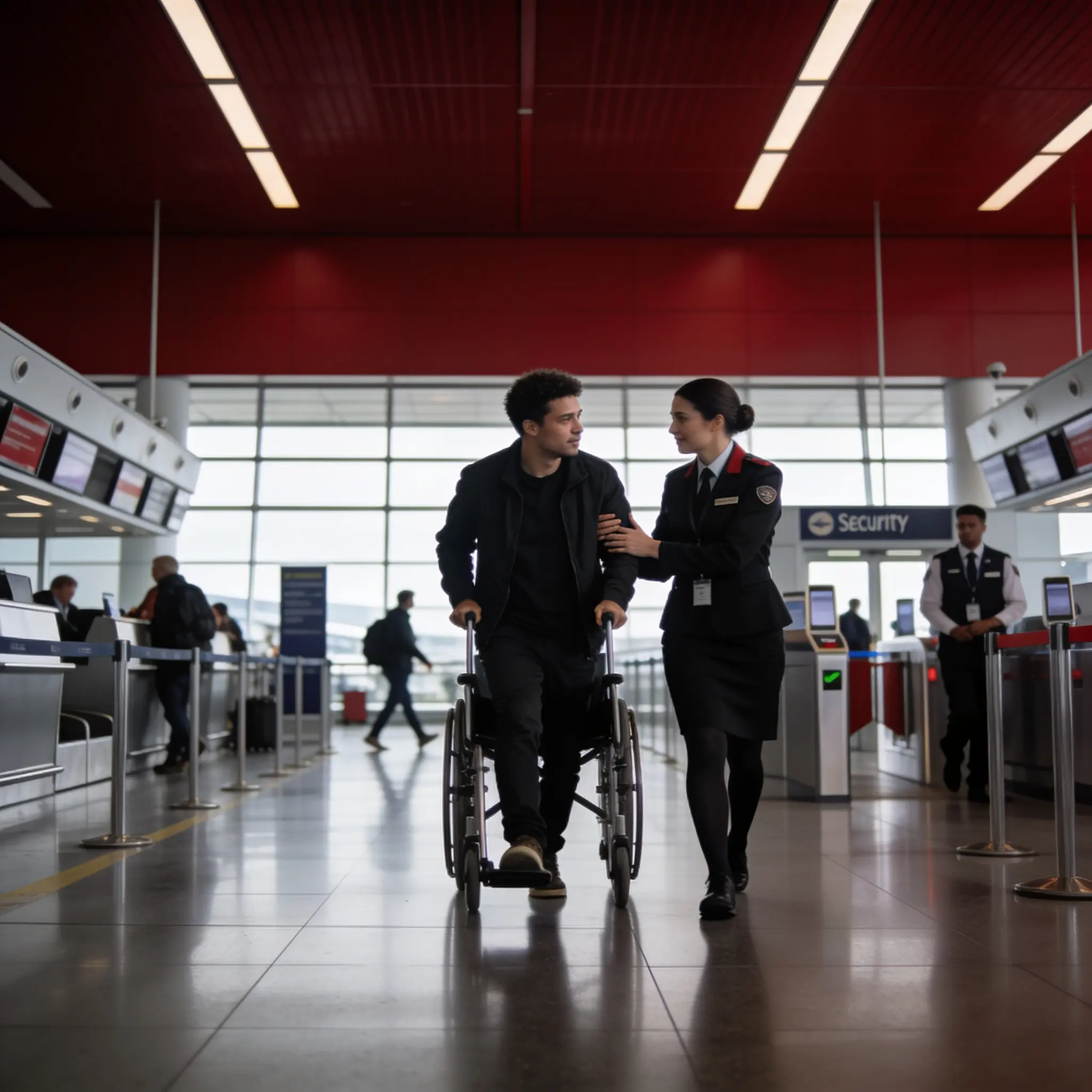

Hidden disabilities are not always visible at the checkpoint. A TSA notification card is one way to notify officers. TSA issues the card. This page does not invent sunflower-lanyard search volume.
What a Notification Card Does
A TSA notification card is a wallet-sized document that lets you communicate your needs to security officers without verbal explanation.
It’s one of the simplest forms of hidden disability travel documentation available, since you hand it to the TSA officer before screening begins and they adjust the process accordingly.
The card provides quick visual confirmation of your accommodation needs, protecting your privacy while helping staff understand how to assist you.
What It Does Not Do
A notification card is not proof of disability and does not replace medical documentation for controlled substances or medical devices. It does not guarantee any specific accommodation, it simply notifies officers that you may need assistance. TSA still requires prescriptions for insulin, syringes, and other supplies. The card works best when paired with other documentation like airline pre-notification or formal medical letters.
Link to the TSA Service Hub
You can download free TSA notification cards and find more information at the TSA Cares service hub. Call (866) 289-9673 before your flight to arrange additional support. The helpline connects you with specialists who coordinate with officers at your departure airport.
We document. TSA issues the card.
What Qualifies as Hidden Disability Travel Documentation and Why You Need It
Hidden disability travel documentation refers to official cards. Letters, or certificates that verify your medical condition to airport staff and airline personnel.
These documents help you access accommodations without explaining your health status repeatedly. They work because they follow recognized formats that security officers and gate agents already know.
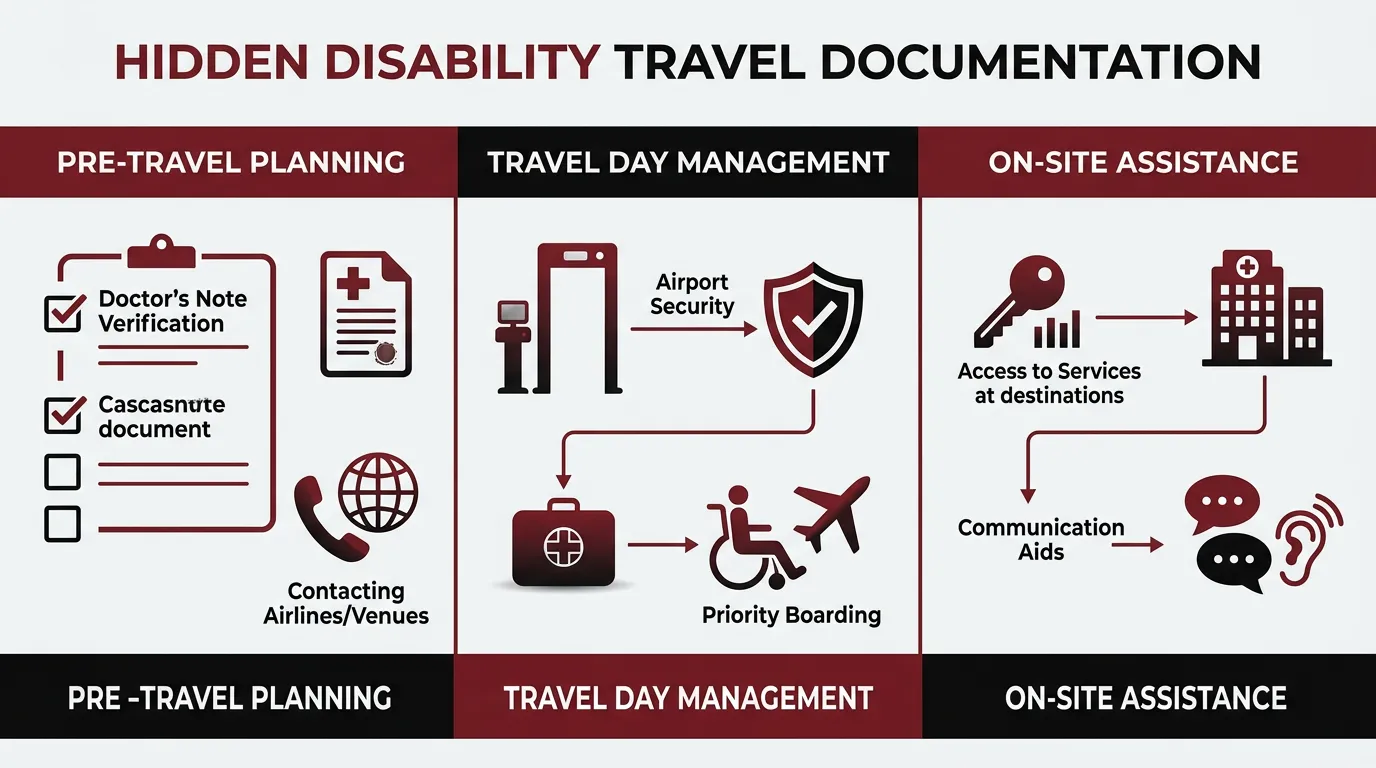
The Air Carrier Access Act protects travelers with disabilities. However, it doesn’t specify which documentation formats airlines must accept. This creates confusion at checkpoints.
Standardized programs solve this problem by providing consistent recognition across all U.S. airports.
Legal Definition of Hidden Disabilities for Travel
Hidden disabilities include conditions that aren’t immediately visible but still affect your ability to travel. Diabetes, chronic pain, mental health conditions, autism, ADHD, chronic fatigue, fibromyalgia, and autoimmune disorders all qualify.
These conditions may require special accommodations during security screening or boarding.
The Americans with Disabilities Act recognizes these conditions as legitimate disabilities. This means you have legal rights to request assistance. Airlines must provide reasonable accommodations when you present proper documentation.
Understanding how anxiety and mental health conditions qualify for travel accommodations helps you know what documentation you need.
Why Standard Medical Records Are Not Enough
Medical records contain too much private information for routine travel use. They also take time to review. Airport staff can’t read through pages of clinical notes during busy security lines. This causes delays and frustration for everyone involved.
Recognized travel documentation provides quick visual confirmation instead. TSA agents and airline staff receive training on specific card formats. They can verify your needs in seconds. This speeds up the process while protecting your privacy.
How Documentation Protects Your Rights Under the Air Carrier Access Act
Proper documentation lets you request wheelchair assistance, priority boarding, and security screening accommodations without invasive questions.
You can also arrange special handling for medical equipment like insulin pumps or oxygen tanks. Programs like TSA Notification Cards, Sunflower Lanyards, and airline disability cards provide this protection.
Without recognized documentation, staff may deny your requests. They might ask you to explain your condition in detail at check-in. This violates your privacy and creates unnecessary stress. Similar to how diabetes documentation protects your rights to workplace and travel accommodations, proper travel cards ensure consistent treatment across all airports and airlines.
A TSA notification card is one of the most widely recognized options for travelers who want to share their needs discreetly. Veterans managing service-connected hidden disabilities can also pair this documentation with veteran benefits to access additional travel support.
TSA Notification Cards and TSA Cares: Official U.S. Airport Documentation
TSA notification cards help travelers with hidden disabilities move through airport security without stress. These wallet-sized cards let you share your needs with TSA officers discreetly. You don’t need to explain your condition out loud.
The cards work best when paired with TSA Cares, a dedicated helpline for travelers who need extra support.
How to Obtain a TSA Notification Card
TSA offers free downloadable notification cards on TSA.gov. You can print them at home on standard paper. For durability, laminate your card at any office supply store.
The card includes space to note your condition and specific accommodation needs. Fill it out clearly before your trip. Keep it in your wallet with your ID so it’s easy to access.
No medical documentation is required to get or use a TSA notification card for hidden disabilities. The card serves as a communication tool, not proof of disability. That said, you still need proper documentation for medical devices and supplies.
What TSA Cares Provides for Travelers with Hidden Disabilities
TSA Cares is a helpline that connects you with passenger support specialists. Call at least 72 hours before your flight to arrange assistance. Same-day help is available if you arrive early.

The service coordinates with TSA officers at your departure airport. A specialist can meet you at security to guide you through screening. This reduces confusion and anxiety during the process.
TSA Cares also answers questions about what you can bring and how screening works. The service is free and available for all travelers with disabilities or medical conditions.
Using Your Card at Security Checkpoints
Present your notification card to the TSA officer before screening begins. Hand it to them along with your boarding pass and ID. The officer will read it and adjust the screening process as needed.
TSA officers receive training to recognize these cards and respond appropriately. They can offer private screening rooms if you prefer. Alternative inspection methods are available for travelers who can’t stand or raise their arms.
The card doesn’t replace medical documentation for insulin pumps or other devices. It supplements that paperwork by explaining your needs without verbal disclosure. Many travelers also use disability parking placards for airport drop-off zones to reduce walking distance before security.
Sunflower Lanyard Program: International Hidden Disability Recognition
The Hidden Disabilities Sunflower program offers a simple way to signal your needs without explaining your condition repeatedly. You wear a green lanyard with sunflowers printed on it. Airport staff trained in the program recognize this symbol. They know you may need extra time, patience, or assistance.
The program started in the UK and has grown rapidly. Over 200 airports worldwide now participate. Major hubs include Heathrow, Gatwick, Dublin, Sydney, and Toronto. In the U.S., participation is growing but still limited.
According to the Salt Lake City airport program, domestic airports are increasingly adopting the initiative to support travelers with non-visible disabilities.
Which Countries and Airports Recognize Sunflower Lanyards
Recognition is strongest in the UK, Australia, Canada, and parts of the EU. Most major UK airports participate fully. Staff receive regular training on the program. Australian airports like Sydney and Melbourne also show strong adoption.
In the U.S., recognition varies significantly by location. Some airports offer free lanyards at information desks. Others have no formal program at all. Airlines also differ in their awareness. British Airways and Qantas train staff extensively. Budget carriers may not recognize the symbol at all.
How to Obtain an Official Sunflower Lanyard
You can buy an official lanyard from hdsunflower.com for around $5 to $10. Many participating airports also distribute them free at customer service desks. Heathrow, Gatwick, and Dublin all offer complimentary lanyards.
No medical documentation is required to obtain or wear one. The program operates on trust and voluntary disclosure. You simply wear the lanyard when you need support. This makes it accessible for people managing conditions like diabetes, autism, or chronic pain who may not carry formal mental health disability documentation while traveling.
Limitations and When Additional Documentation Is Required
The sunflower lanyard is not legally binding. It does not replace medical documentation for controlled substances or medical devices. TSA still requires prescriptions for insulin, syringes, and other diabetes supplies.
Staff training varies widely. Some airports train all customer-facing employees. Others train only a small team. This means your experience depends heavily on which staff member you encounter. Brexit has also complicated UK-EU travel. Some EU airports do not consistently recognize UK disability cards. The sunflower lanyard offers a more universal alternative in these situations.
Airline-Specific Disability Assistance Cards and Pre-Notification Systems
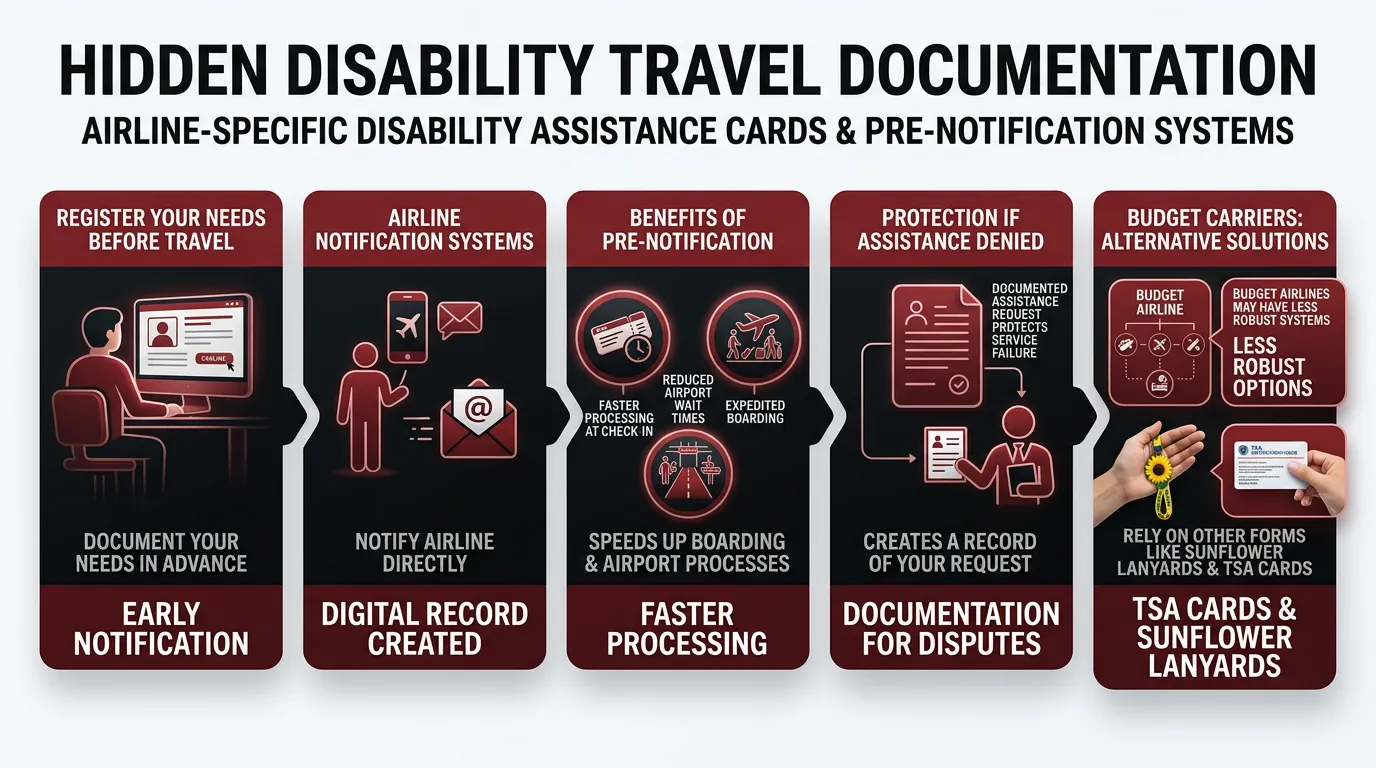
Most major airlines offer pre-notification systems that let you document your needs before you reach the airport. These systems create a record of your request. They don’t guarantee service but protect you if assistance gets denied.
United Airlines Accessibility Services
United Airlines provides a dedicated accessibility line and online form. You can request wheelchair help, priority boarding, and cognitive disability support. The system lets you add these requests directly to your reservation.
You can call their accessibility desk or use the online portal. Both options let you document your needs in advance. This creates a paper trail if services fail to show up.
Delta and American Airlines Disability Documentation
Delta’s online portal uses Special Service Request codes. You can add medical equipment notifications and assistance needs to your booking. American Airlines offers a similar system through their website.

According to the Air Carrier Access Act, airlines must provide disability accommodations at no extra charge. Both carriers let you submit requests up to 48 hours before departure. Some requests need more advance notice.
How to Pre-Register Your Needs Before Travel
Start by calling the airline’s accessibility line when you book. Add your requests to your reservation confirmation. Keep a copy of all documentation.
Some airlines issue physical disability cards after you complete registration. You can show these cards at check-in for faster processing. This speeds up the boarding process.
Low-cost carriers often have less robust systems. Budget airlines may not offer pre-notification options. For these flights, TSA notification cards and sunflower lanyards become more important.
What to Do When Your Hidden Disability Documentation Is Rejected or Ignored
Airport staff sometimes refuse to honor hidden disability travel documentation. This happens even when you carry proper medical letters or TSA notification cards. When this occurs, you need to act fast to protect your rights.
Immediate Escalation Steps at the Airport
If a gate agent or TSA officer denies your request, ask to speak with a supervisor right away. Don’t leave the checkpoint or gate area without escalating. Request a Customer Service Manager for airline issues or a TSA Supervisor for security screening problems.
Document everything during the interaction. Write down the employee’s name, badge number, exact time, and location. Note exactly what they said and what accommodation you requested. Take photos of your documentation if it’s safe to do so.
According to the TSA Cares helpline service, travelers with disabilities can contact for assistance 72 hours before their flight. This creates a record of your needs before you even arrive at the airport.
Filing Formal Complaints with Airlines and TSA
File a complaint with the airline’s disability assistance office within 24 hours. Reference the Air Carrier Access Act in your complaint. This federal law requires airlines to provide assistance to passengers with disabilities.
For TSA issues, submit a complaint through the TSA Contact Center immediately. Include all documentation you collected at the checkpoint. The complaint creates an official record that strengthens any future claims.
The Department of Transportation investigates Air Carrier Access Act violations. Airlines that systematically deny documented assistance face significant fines. Your complaint contributes to enforcement actions that protect other travelers.
How Rocket Records Helps You Document Denied Assistance
Rocket Records provides formal medical documentation that strengthens your travel claims. The platform generates letters from licensed healthcare providers that meet airline and TSA requirements. This documentation carries more weight than self-written notes.
The service also provides templates for filing complaints with airlines and federal agencies. These templates include the specific legal language and references that make complaints more effective. You don’t need to research regulations yourself.
Repeated denials may qualify you for legal assistance through disability rights organizations. Documentation from Rocket Records supports those claims by proving you had proper paperwork.
This evidence is critical if you need to pursue legal action.
Conclusion
Hidden disability travel documentation gives you the tools to travel without constant explanations or confrontations.
TSA notification cards work at security checkpoints. Sunflower lanyards signal your needs internationally. Airline pre-notification systems document your requirements before you board. Each serves a different purpose, and smart travelers use all three together.
You now know what qualifies as valid documentation. You understand how to get TSA notification cards and register for TSA Cares assistance.
You can obtain a sunflower lanyard and use airline-specific disability assistance cards. You also know what to do when staff reject or ignore your paperwork.
Don’t wait until you’re at the airport to discover you need better documentation. Get the cards, letters, and certificates that protect your rights now. Prepare before your next trip so you can focus on your destination instead of fighting for basic accommodations.
Rocket Records helps people with diabetes, chronic illness, mental health conditions, and autism access airline disability assistance documentation and other benefits they qualify for.





 Ask ChatGPT
 Ask Claude
 Ask Perplexity