


Most people think claiming disability benefits means months of paperwork, long phone calls with government offices, and a process so hard that you need a lawyer just to get started. That picture is out of date.
The question how do I claim disability benefit has a much simpler answer than most people expect. You can find out exactly what you qualify for in under five minutes, and you can handle most of the process from your phone or computer without ever setting foot in a government office.
Rocket Records was built to make this easy. The platform uses AI to scan more than 25 federal and state benefit programs, match them to your health conditions, pre-fill your paperwork, and connect you with state-licensed physicians for any medical forms you need. And for people who are already receiving benefits, this guide also covers what you need to know about a claim for continued disability benefits, including when the SSA reviews your case and what to expect.
Whether you are just starting out or you have been on benefits for years, this guide walks you through everything you need to know about how the process works and how Rocket Records can help you get more done in less time.
What Most People Get Wrong About Claiming Disability Benefits
Before we get into how Rocket Records works, it helps to clear up a few common beliefs that stop people from getting the benefits they are owed. According to the Social Security Administration, millions of Americans who qualify for disability benefits never apply at all. Here is why that happens.
4 Common Myths About Claiming Disability Benefits
Myth 1: You need a lawyer to apply. You do not. Many people apply and get approved on their own, especially when they use a platform that handles the paperwork for them.
Myth 2: SSDI and SSI are the only programs available. There are more than 25 programs that people with health conditions may qualify for, including prescription help, tax credits, parking permits, and more.
Myth 3: Finding out what you qualify for takes weeks. With Rocket Records, you can see your full list of benefits in under five minutes.
Myth 4: You have to visit a government office in person. Almost everything can be done online, including applying for SSDI, submitting medical certifications, and completing disability reviews.
The real barrier for most people is not the process itself. It is not knowing what they qualify for or where to begin. Rocket Records was designed to solve both of those problems at the same time.
Most users come to the platform thinking they might qualify for one or two programs. They leave with a list of five to ten benefits they had never heard of before. That gap between what people know about and what they actually deserve is exactly what Rocket Records closes.
How Rocket Records Works: A Step-by-Step Walkthrough
The process at Rocket Records is built around one goal: getting you from ‘I think I might qualify’ to ‘here is my full benefits list’ as fast as possible. You can access the platform through RocketRecords and most users are through the key steps in under five minutes.
-
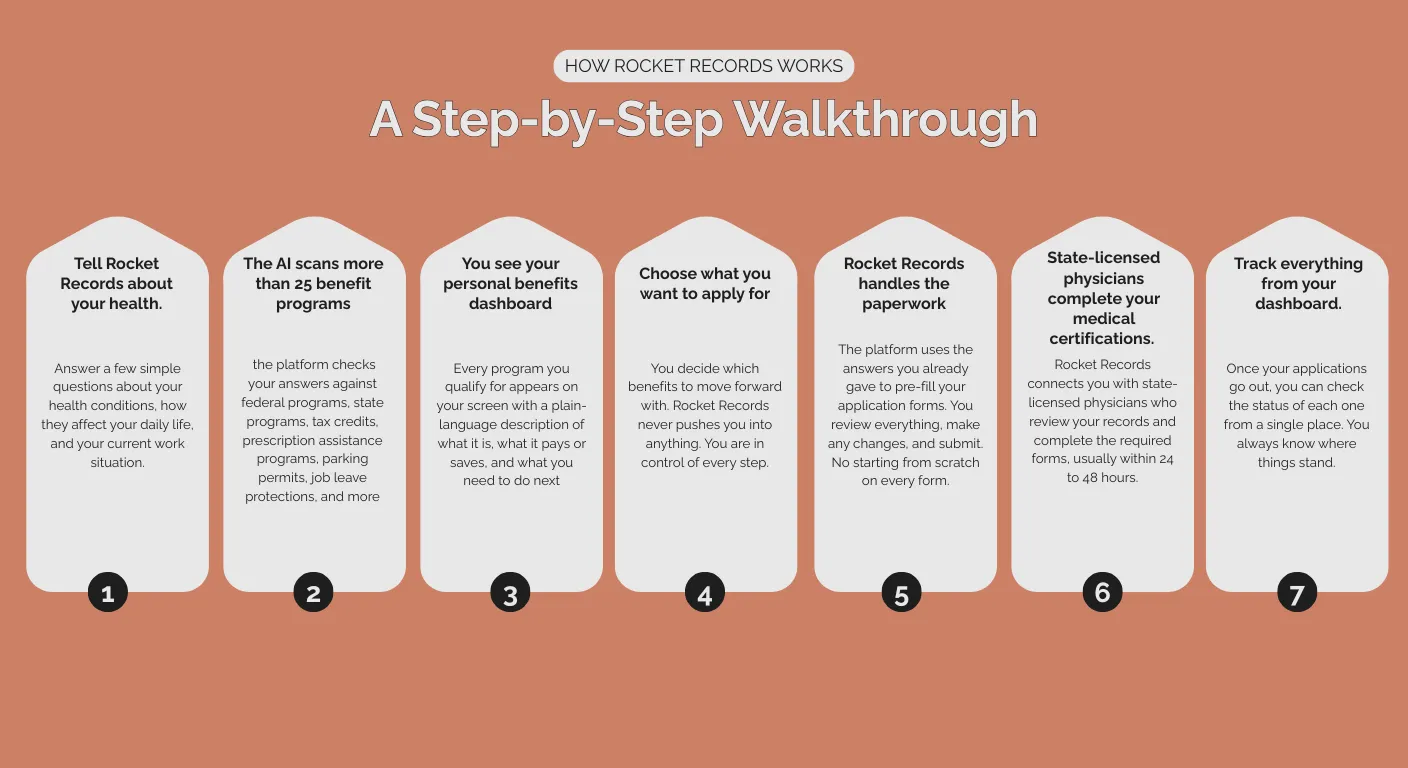
Tell Rocket Records about your health. Answer a few simple questions about your health conditions, how they affect your daily life, and your current work situation. You do not need medical records in hand to start. The questions take about two minutes to complete.
-
The AI scans more than 25 benefit programs. In a matter of seconds, the platform checks your answers against federal programs, state programs, tax credits, prescription assistance programs, parking permits, job leave protections, and more. Every program is checked, not just the ones you already know about.
-
You see your personal benefits dashboard. Every program you qualify for appears on your screen with a plain-language description of what it is, what it pays or saves, and what you need to do next. Nothing is buried in legal language.
-
Choose what you want to apply for. You decide which benefits to move forward with. Rocket Records never pushes you into anything. You are in control of every step.
-
Rocket Records handles the paperwork. The platform uses the answers you already gave to pre-fill your application forms. You review everything, make any changes, and submit. No starting from scratch on every form.
-
State-licensed physicians complete your medical certifications. Some benefits require a licensed physician to sign off on your medical condition. These include FMLA leave paperwork, handicap parking placards, ESA letters, and PSD letters. Rocket Records connects you with state-licensed physicians who review your records and complete the required forms, usually within 24 to 48 hours.
-
Track everything from your dashboard. Once your applications go out, you can check the status of each one from a single place. You always know where things stand.
The whole discovery process, from answering the health questions to seeing your full benefits list, takes under five minutes in most cases. Applying for each benefit takes a bit more time, but the pre-filled forms cut the work down a lot more than starting from scratch on each program.
Ready to See What You Qualify For?
Answer a few simple questions about your health and Rocket Records’ AI will show you every benefit you are entitled to across more than 25 federal and state programs. Pre-filled paperwork. State-licensed physicians. Most users see their full dashboard in under five minutes.
Check Your Eligibility Free at RocketRecords
How Do I Claim Disability Benefits? Programs Rocket Records Can Help You Find
When people ask how do I claim disability benefit, they usually mean SSDI or SSI. But those two programs are just the start. Here is a look at the full range of programs that Rocket Records can identify and help you apply for.
Federal Disability Programs
SSDI (Social Security Disability Insurance). This program is based on your work history. To qualify, you need to have worked and paid Social Security taxes for a certain number of years. SSDI provides monthly payments and leads to Medicare coverage after 24 months of receiving benefits.
SSI (Supplemental Security Income). This program is based on financial need rather than work history. It is available to people with low income and limited assets who have a qualifying disability. SSI often leads to Medicaid coverage right away.
VA Disability Pay. Veterans with a service-connected health condition may qualify for monthly payments from the VA. According to the VA disability compensation, you can receive VA disability pay at the same time as SSDI without any offset.
Job and Income Protection
FMLA Leave Protection. The Family and Medical Leave Act protects your job while you are getting treatment for a serious health condition. A licensed physician must complete the required forms. Rocket Records connects you with a physician who can handle this within 24 to 48 hours.
State Short-Term Disability Programs. California, New York, New Jersey, Rhode Island, and Hawaii all have state-run programs that provide income replacement during periods of short-term disability. These can bridge the gap while an SSDI application is being reviewed.
Cost-Saving Benefits
-
Prescription assistance programs: save between $1,200 and $4,000 per year on medication costs
-
Disability tax credits from the IRS: worth between $3,750 and $7,500 for qualifying individuals
-
Utility discount programs: reduced monthly energy bills for people with qualifying conditions
-
National Park lifetime access pass: free for people with permanent disabilities
-
Student loan discharge: available to people with total and permanent disability
Housing and Travel Benefits
-
Handicap parking placards: free accessible parking for people with mobility or chronic conditions
-
ESA letters: housing protections for people with mental health conditions who need an emotional support animal
-
PSD letters: additional travel and access protections for psychiatric service dog owners
Benefits Rocket Records Can Help You Find
| Program | Who It Helps | Value Per Year |
|---|---|---|
| SSDI | Workers with disability and work history | Avg. $1,537/month |
| SSI | Low-income adults with disability | Up to $943/month |
| VA Disability Pay | Veterans with service conditions | Based on rating |
| FMLA Leave | Workers needing medical time off | Job protection |
| Prescription Help | People with chronic conditions | $1,200 to $4,000 |
| Disability Tax Credits | Working-age adults with disability | $3,750 to $7,500 |
| Handicap Parking Placard | Mobility and chronic conditions | $300 to $500 |
| Utility Discounts | People with disability or low income | $200 to $400 |
| Student Loan Discharge | Total and permanent disability | Full loan balance |
| ESA or PSD Letter | Mental health conditions | Housing and travel access |
What Is a Claim for Continued Disability Benefits?
Getting approved for SSDI or SSI is not the end of the process. The SSA (Social Security Administration) checks from time to time to confirm that you still qualify for benefits. This check is called a Continuing Disability Review, or CDR. Knowing how CDRs work can save you a lot of stress if and when one comes your way.
As of March 2026, the SSA announced that all medical CDRs will now be handled directly by its federal processing site called the federal Disability Case Review office, rather than being sent out to state offices. According to the SSA’s continuing disability review information, this change is expected to make the review process faster and more consistent for everyone receiving benefits.
How Often Will the SSA Review Your Case?
The frequency of your CDR depends on the nature of your condition and whether the SSA expects it to improve over time. Here is how the schedule works.
CDR Schedule Based on Improvement Expectation
| Your Condition Type | When the SSA Will Review |
|---|---|
| Improvement is expected | Every 6 to 18 months after approval |
| Improvement is possible | About every 3 years |
| Improvement is not expected | About every 7 years |
Your initial approval notice from the SSA will tell you when to expect your first review. Keep that notice somewhere safe so you are not caught off guard.
What Triggers a CDR Outside the Regular Schedule?
-
You report a change in your health condition to the SSA
-
You go back to work or start earning above the monthly limit ($1,690 in 2026)
-
A third party reports to the SSA that your condition may have improved
-
You miss required check-ins or fail to respond to SSA notices
What the SSA Looks at During a CDR
During a CDR, the SSA looks at your most recent medical records, your current treatment history, whether you have gone back to work, and whether your condition has improved enough to allow you to do substantial work again. If you have kept up with medical treatment and your condition has not improved, your benefits will almost always continue without a break.
The most important thing you can do to protect your benefits during a CDR is to respond quickly to any notices from the SSA and keep your medical records current. Delays in responding can result in your benefits being paused while the SSA waits for your information.
What If the SSA Says You Have Improved?
If the SSA determines that your condition has improved and that you can now work, they will notify you by mail. You have the right to appeal this decision. In most cases, you can continue to receive your benefits during the appeal period. You have 60 days from the date of the notice to file your appeal, so it is important to act quickly.
Rocket Records keeps your medical certifications and health records organized within your dashboard, which makes it much easier to pull together what you need when a CDR notice arrives.
What Happens After You Submit Your Applications?
Different benefits move at different speeds after you submit your applications. Here is what to expect for each type.
SSDI and SSI Applications
After you submit an SSDI or SSI application, the SSA reviews it for basic eligibility and then sends it to your state’s disability review office for a medical review. This review process usually takes between three and seven months, though wait times can be longer when many applications come in at once.
As of early 2026, the SSA has reduced its initial claims backlog by more than 33 percent compared to the all-time high reached in 2024. The agency is on track to complete more than 2.3 million initial disability decisions in 2026. That means decisions are moving faster than they were a year or two ago.
If your application is denied, you have 60 days to file an appeal. Around 62% of initial applications are denied, but many of those people are approved at the appeal stage. Filing an appeal is your right, and Rocket Records can help you stay organized throughout that process.
Medical Certifications Through Rocket Records
For benefits that require a physician to sign off, such as FMLA paperwork, handicap parking placards, ESA letters, and PSD letters, state-licensed physicians review your records and complete the required forms within 24 to 48 hours in most cases. These forms go directly to your employer, your state DMV, or your housing provider, depending on the benefit.
Tax Credits and Prescription Programs
Disability tax credits are processed through the IRS during your regular tax filing. Rocket Records pre-fills the required IRS forms to reduce errors and increase the chance of approval. Prescription assistance programs typically confirm enrollment within a few weeks, depending on the specific program.
Track Every Application From One Place
Once your applications are submitted, you can check the status of each one from your Rocket Records dashboard. Everything lives in one place, so you never have to wonder which benefits are in progress, which have been approved, and which might need follow-up. This is especially useful when you are managing several programs at once.
Why People Choose Rocket Records Over Going It Alone
Some people try to research and apply for disability benefits on their own. That is absolutely possible, and we want you to do whatever works best for your situation. But here is an honest look at what the two approaches actually involve.
Going It Alone vs. Using Rocket Records
| Going It Alone | Using Rocket Records |
|---|---|
| Research 25+ programs across multiple government websites | AI scans all 25+ programs in seconds based on your health |
| Fill out each application form from scratch | Forms are pre-filled using answers you already gave |
| Schedule your own doctor appointment for each medical cert | State-licensed physicians available within 24 to 48 hours |
| No guarantee you found everything you qualify for | Every program is checked, nothing is missed |
| No organized tracking of what is in progress | Single dashboard tracks all applications in one place |
| No safety net if an application is denied | 100% money-back guarantee if your application is denied |
The biggest risk of going it alone is not the paperwork. It is not knowing what you missed. Most people who apply for disability benefits on their own focus entirely on SSDI or SSI and never learn that they also qualify for prescription savings, a parking placard, job leave protection, or tax credits worth thousands of dollars.
Rocket Records has helped more than 250,000 Americans find and claim benefits they were entitled to. You can check what you qualify for at no risk by visiting RocketRecords if you have questions before getting started.
The platform is HIPAA-compliant, which means your health data is kept private and secure. And if any of your applications are denied, you get your money back. There is nothing to lose by finding out what you qualify for.
Conclusion
Knowing how do I claim disability benefit is the first step. But the more important question is: how many benefits are you actually entitled to that you have never claimed?
Most people with a qualifying health condition are owed far more than just SSDI or SSI. Prescription savings, tax credits, job leave protection, parking permits, and more are all available to people who know where to look. Rocket Records makes sure you do not miss any of them.
And for people who are already on benefits, staying on top of your claim for continued disability benefits through regular CDRs is just as important as applying in the first place. Keeping your records current, responding to SSA notices on time, and understanding your appeal rights can make a real difference in whether your benefits continue without a break.
Rocket Records handles the discovery, the paperwork, the medical certifications, and the tracking so you can focus on your health. Most users see their complete benefits list in under five minutes, with no commitment and no cost to check.
Start Finding Your Benefits in Under 5 Minutes.
Rocket Records scans more than 25 benefit programs, finds everything you qualify for, and handles the paperwork. State-licensed physicians complete your medical forms within 24 to 48 hours. Most users see their full benefits list in under five minutes, with no commitment and no cost to check.





 Ask ChatGPT
  Ask Claude
  Ask Perplexity