



The Access Pass vs Disabled Discount Pass debate confuses thousands of people each year. Both passes cut costs for people with disabilities. But they work in completely different ways. One gives you free entry to federal recreation sites. The other offers discounts on transit, utilities, and local services. Most people qualify for both but only claim one. That mistake costs hundreds or thousands of dollars annually.
This guide breaks down what each pass covers and who qualifies. You’ll learn how much money each one saves. We’ll show you how to apply for an America the Beautiful Access Pass and where to find disabled transit pass savings in your state. You’ll also discover whether you can use multiple disability passes at the same time. The answer might surprise you.
We’ll walk through eligibility requirements for both pass types. Then we’ll compare costs side by side so you can see real savings. You’ll get step-by-step application instructions for 2026. Plus, you’ll learn how platforms like Rocket Records match your health conditions to every pass you qualify for automatically.
Understanding the Access Pass vs Disabled Discount Pass difference helps you claim every benefit you deserve. Let’s start with what an access pass actually does.
Here’s a quick comparison of the two programs and how Rocket Records can help:
| Category | America the Beautiful Access Pass | Disabled Discount Pass | Rocket Records |
|---|---|---|---|
| Issuer | Federal government through participating federal recreation agencies | State or local agency, depending on the specific program | Helps users with eligibility, documentation, and the application process |
| What it covers | Applicable entrance and standard amenity fees at participating federal recreation sites. It may also provide discounts on certain expanded amenity fees. | Benefits vary by program and location. They may include discounts for state parks, transit, utilities, or other services. | Helps users identify relevant programs and supports the documentation and application process |
| Who qualifies | U.S. citizens or residents with a medically determined permanent disability that severely limits one or more major life activities | Eligibility varies by program and location | Matches users with programs based on their information |
What Is an Access Pass and How Does It Work? Access Pass vs Disabled Discount Pass Explained
An Access Pass is a federal recreation pass that gives people with permanent disabilities lifetime free entry to over 2,000 federal sites. These sites include national parks, forests, wildlife refuges, and recreation areas. The pass is free and valid for the lifetime of the pass holder.
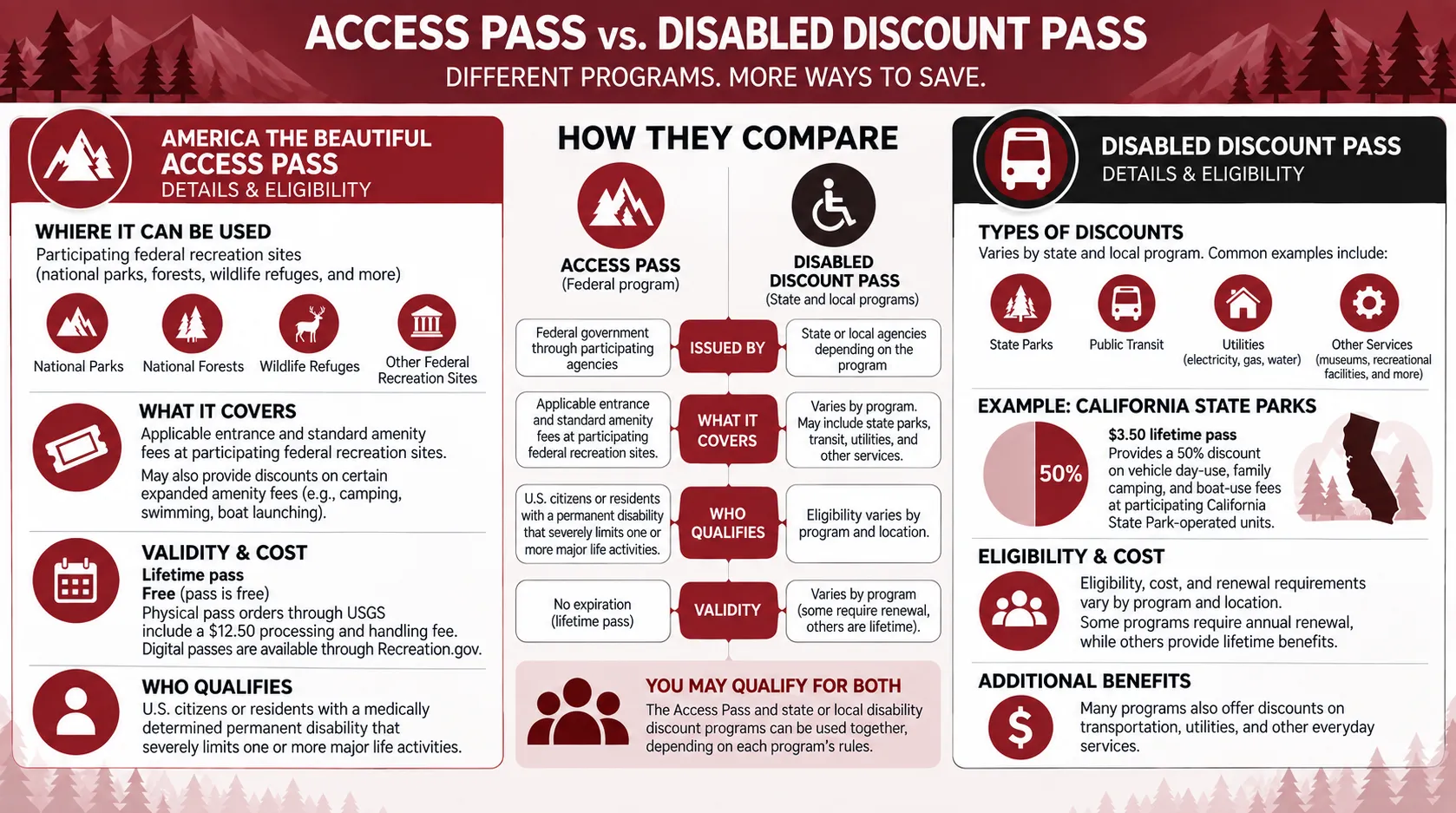
The America the Beautiful Access Pass is the most recognized version. It’s rooted in federal recreation law and public lands policy, not the Americans with Disabilities Act. This distinction matters when comparing national park passes and federal recreation access programs to other discount programs.
Federal Access Pass Program and Eligibility
To qualify for an Access Pass, you must be a U.S. citizen or resident with a permanent disability that severely limits one or more major life activities. Documentation can include a statement from a licensed physician. It can also include proof of receiving federal disability benefits. State agency documentation confirming disability status works too.
You can get the pass in person at participating federal recreation sites. You can also apply by mail through the U.S. Geological Survey. You can also get a digital Access Pass through Recreation.gov and use it immediately. The application process is straightforward. You need to show proof of disability and complete a short form.
Many people who qualify for disability benefits through federal health and assistance programs also meet Access Pass eligibility requirements. This includes people with mobility limitations, vision impairments, and chronic conditions that affect daily functioning.
What Access Passes Cover Nationwide
The Access Pass covers applicable entrance and standard amenity fees at participating federal recreation sites. This includes iconic locations like Yellowstone, Yosemite, and the Grand Canyon. It also covers day-use fees at national forests and wildlife refuges.
Beyond free entry, the pass provides a 50% discount on expanded amenity fees. The exact discount depends on the site and agency. These fees include:
-
Camping at federal campgrounds
-
Swimming facility access
-
Boat launching fees
-
Specialized interpretive services
The pass does not cover fees charged by private concessionaires. It also doesn’t cover special recreation permits or fees charged by state or local agencies within federal lands.
Companion and Carer Benefits
One of the most valuable features of the Access Pass is companion coverage. At per-vehicle sites, the pass covers the pass holder and passengers in the same private, noncommercial vehicle. This benefit is rarely found in disabled discount passes.
If you enter a site on foot, bike, or by other non-vehicle means, the pass covers you plus three adults. Children under 16 are always free regardless of pass type. This makes family trips to federal recreation sites significantly more affordable.
State-level access passes exist in California, New York, and other states. These programs have similar structures but different eligibility requirements. Some states require annual renewal. Others offer permanent passes like the federal program. Benefits and coverage vary by state, so check your local program for specific details.
What Is a Disabled Discount Pass and How Is It Different?
A disabled discount pass is a benefit program that offers reduced pricing on services like transportation, utilities, recreation, and entertainment. These passes help people with disabilities save money on everyday expenses. They work differently from federal recreation passes in several key ways.
Unlike the America the Beautiful Access Pass, disabled discount passes don’t follow a single standardized nationwide program. Each program sets its own rules, eligibility requirements, and application processes. This means what you qualify for in one state may not exist in another.
Discount Programs vs. Federal Recreation Passes
The federal Access Pass provides lifetime entry to national parks and federal recreation sites at no cost. It covers one person with a permanent disability plus three adults. Disabled discount passes, on the other hand, focus on local and state-level services.
These programs target different needs. A transit pass reduces your daily commute costs. A utility discount lowers your monthly bills. A state park pass gives you affordable recreation close to home. Each program operates independently with its own agency.
According to California State Parks, state-level disabled discount passes often require annual renewal and proof of disability status. This contrasts sharply with the federal Access Pass, which lasts a lifetime once approved.
Common Disabled Discount Pass Programs
Several types of disabled discount passes exist across the country. Here are the most common ones:
-
Disabled transit passes that reduce or eliminate fares on buses, trains, and paratransit services
-
Senior and disabled utility discounts that lower electricity, gas, and water bills by 10-30%
-
State park discount passes that provide reduced entry fees to state recreation areas
-
Entertainment and cultural venue discounts for museums, theaters, and attractions
Each program serves a specific purpose. Transit passes help with mobility. Utility discounts ease household expenses. State park passes make recreation accessible. The combined savings can reach hundreds of dollars per year.
Cost Structure and Renewal Requirements
Disabled discount programs have different renewal rules. Some require renewal, while others provide lifetime benefits. You’ll need to reapply each year and submit updated documentation. Some programs charge a small processing fee, typically $5 to $25.
Many programs are income-tested. You may need to show you receive disability benefits like SSDI or SSI. Others require proof of permanent disability from a licensed physician. The disabled discount pass application process varies by program and location.
Companion benefits are rare with these passes. Most cover only the person with the disability. This differs from the federal Access Pass, which includes three additional adults. Plan accordingly when budgeting for family outings or shared expenses.
Eligibility Requirements: Access Pass vs. Disabled Discount Pass
Understanding the eligibility requirements for Access Pass vs Disabled Discount Pass programs helps you claim the right benefits. Each program has distinct documentation standards, income thresholds, and disability definitions. Knowing these differences saves time and prevents application rejections.
Medical Documentation Standards
Access passes require documentation of a permanent disability that substantially limits one or more major life activities. This includes mobility, vision, hearing, or cognitive function. The disability must be long-term or indefinite.

You can prove eligibility with a signed physician statement or qualifying documentation from a federal or state agency. Federal agency documentation must establish entitlement to disability benefits.
Disabled discount passes accept broader documentation types. Many programs accept proof of receiving federal disability benefits. Others require a simple physician statement confirming your condition. Some accept Medicare or Medicaid enrollment as automatic qualification.
According to Washington State disability pass eligibility guidelines, medical documentation must clearly state the nature of the disability and its functional impact. A licensed healthcare provider must sign the form. The signature must be from the past 12 months.
State park systems often accept less formal documentation than federal programs. A letter from your doctor describing your condition may be enough. Transit agencies sometimes accept disability parking placards as proof.
Income Requirements and Means Testing
Access passes typically do not include income requirements. Your disability status alone determines eligibility. This makes them accessible to people at all income levels.
Disabled discount passes often include means testing. Utility discount programs may require income below 150% of the federal poverty level. Transit passes might cap eligibility at 200% of poverty guidelines. Property tax exemptions vary widely by state.
Some programs combine disability and income requirements. You must meet both criteria to qualify. Others offer tiered discounts based on income level. Higher discounts go to those with lower incomes.
Rocket Records helps users determine which documentation they already have and which passes they qualify for based on their specific health conditions and income level. The platform cross-references your information against thousands of programs in seconds.
Permanent vs. Temporary Disability Status
Access passes require permanent disability status in most cases. The condition must last for your whole life or can cause death. Temporary injuries or short-term conditions do not qualify.
Disabled discount passes may be available to people with temporary disabilities or chronic conditions that do not meet the federal permanent disability standard. A broken leg requiring crutches for three months might qualify for temporary transit discounts. Chronic pain conditions that limit mobility can qualify even without a permanent disability determination.
Some programs offer both permanent and temporary passes. Permanent passes never expire and require one-time documentation. Temporary passes last six months to two years and require renewal with updated medical certification.
Understanding qualifying health conditions for each program type helps you apply for the right benefits. Chronic conditions like diabetes, arthritis, or heart disease often qualify for discount passes even when they do not meet permanent disability standards for federal access passes.
The distinction matters because it affects which programs you can access. Someone with a temporary disability might qualify for local utility discounts and transit passes. They would not qualify for the lifetime America the Beautiful Access Pass until their condition becomes permanent.
Cost Comparison: Which Pass Saves You More Money?
When you compare the Access Pass vs Disabled Discount Pass, the real question is how much each one saves you. Both passes cut costs in different areas. The trick is knowing which one fits your life best.
Let’s break down the numbers so you can see where your money goes.
Annual Value of Access Passes
The America the Beautiful Access Pass may save you $80 per year. That’s based on the standard annual pass price. But the real value shows up over time.
For people who visit parks regularly, the lifetime value adds up fast. Over 25 years, that’s over $2,000 in savings. State access passes add even more value.
-
California state parks offer free day-use entry for disabled access pass holders
-
New York provides similar benefits at state recreation areas
-
Families save $50 to $200 per year depending on how often they visit
These passes also cover camping discounts at many federal sites. The 50% reduction on expanded amenity fees means your savings grow with each trip.
Annual Value of Disabled Discount Passes
Disabled transit passes deliver bigger annual savings for most people. Commuters in major cities save $600 to $1,200 per year through reduced fare programs. Transit savings vary by city, transit system, fare structure, and how often you travel.
According to the Federal Transit Administration, federally subsidized transit providers generally cannot charge more than half the peak fare for fixed-route transit during off-peak hours to eligible seniors, people with disabilities, and Medicare cardholders. This is a federal transit funding requirement, not an Americans with Disabilities Act requirement.
Utility discount passes add another layer of savings. States with disability-based rate reduction programs help you cut $200 to $400 per year on electricity, gas, and water bills.
-
Transit savings: $600-$1,200 annually in metro areas
-
Utility discounts: $200-$400 per year on home energy costs
-
Combined disabled discount value: $800-$1,600 annually
These programs don’t require park visits or travel. You save money on expenses you already have.
Using Both Benefits Together
Here’s where it gets interesting. You don’t have to choose one or the other. Most people qualify for both types of passes at the same time.
The combined annual value ranges from $800 to $2,000 per year. That number depends on your location, how often you use each benefit, and which specific programs you qualify for.
Transit and utility savings happen automatically once you enroll. Park pass savings grow with each visit. Together, they create a complete savings strategy that covers both daily expenses and recreation.
The key is claiming all the benefits you qualify for. Most people leave money on the table by not applying for every program available to them.
How to Apply for an Access Pass in 2026
Getting an Access Pass is simpler than most people think. You have multiple paths to choose from. Each one works differently based on where you live and how quickly you need the pass.
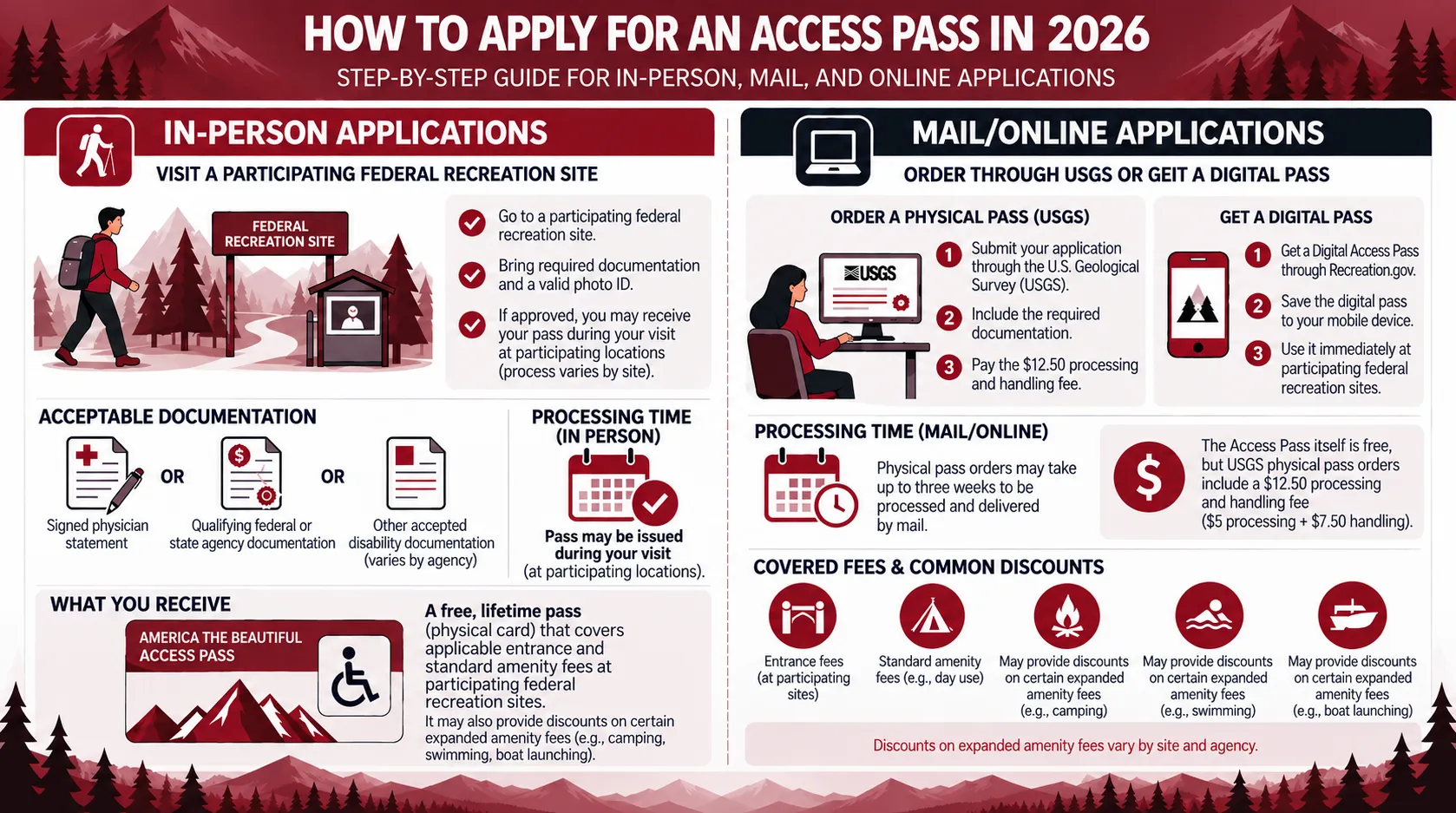
The process varies by state and program type. Some passes arrive the same day. Others take a few weeks. Knowing which option fits your situation saves time and frustration.
Federal Access Pass Application Process
The America the Beautiful Access Pass gives you lifetime access to federal recreation sites. You can get it two ways: in person or by mail.
For in-person applications, visit any participating federal recreation site. Bring proof of your permanent disability. This includes a physician certification form, Social Security disability award letter, or VA disability rating letter. Staff processes your application right away. You walk out with your pass the same day.
Mail applications work differently. According to the USGS Access Pass application page, you submit your documentation through the U.S. Geological Survey. Processing takes 3 to 4 weeks. The pass arrives at your home address once approved.
The Access Pass itself is free, but USGS physical-pass orders currently include $12.50 in shipping and handling fees. The pass never expires. It covers entrance fees at more than 2,000 federal sites nationwide.
State Access Pass Programs
State programs offer similar benefits but work independently from federal passes. California and New York run two of the most accessible programs in 2026.
California residents apply through the California State Parks website. The online process takes about 15 minutes. You can also apply in person at any state park office. Both methods require proof of disability. California’s Disabled Discount Pass provides a 50% discount on vehicle day-use, family camping, and boat-use fees at participating California State Park-operated units.
New York offers the Access Pass for free to residents with permanent disabilities. You apply online or visit any park office. Same-day issuance is standard for in-person applications. The pass covers entrance fees and provides discounts on camping and other amenities.
Other states run similar programs. Check your state parks website for local options. Many states process applications faster than federal programs.
Required Documentation and Processing Time
Documentation requirements stay consistent across most programs. You need proof of your permanent disability. Federal and state programs may accept different types of disability documentation.
-
Social Security disability award letter showing current benefits
-
Physician certification form signed by a licensed doctor
-
VA disability rating letter with your percentage rating
Processing time depends on your application method. In-person applications at federal or state sites process immediately. You leave with your pass the same day.
Mail applications take longer. Federal passes through USGS take 3 to 4 weeks. State programs vary, but most process within 2 to 3 weeks. Online applications through state websites often process faster than mail submissions.
Keep copies of all documentation. Some programs require renewal every few years. Having your paperwork ready speeds up future applications.
How to Apply for Disabled Discount Passes in 2026
Getting access to disabled discount passes can save you hundreds of dollars each year. The application process varies by program type. Each one has different requirements and documentation needs.
Most programs need proof of your disability status. This can come from Social Security, Medicare, or a doctor’s note. Some programs also check your income level.
Transit Discount Pass Applications
Local transit agencies issue disabled transit passes directly. You need to show proof of disability through Social Security benefits, Medicare enrollment, or physician certification. The process takes about two to four weeks.
First, contact your local transit authority to get the application form. Then, have your doctor complete the medical certification section. After that, submit the form with copies of your disability documentation.
Most cities offer reduced fares of 50% or more with these passes. Some transit systems also provide free companion passes. You can renew these passes annually or get permanent status if your disability won’t change.
Utility Discount Program Enrollment
State public utility commissions run utility discount programs for people with disabilities. These programs cut your monthly electric, gas, and water bills by 15% to 30%. You need to verify your income and disability status each year.
To apply, visit your state’s public utility commission website. Download the application form and gather your income documents. You’ll need recent pay stubs or tax returns plus disability documentation.
The income limits vary by state but typically range from 150% to 200% of the federal poverty level. Processing takes four to six weeks. Your discount starts the month after approval.
Recreation and Entertainment Discounts
Museums, theaters, and entertainment venues offer disabled discount admission at the door. Most don’t issue formal passes. You show proof of disability each time you visit.
Acceptable proof includes a Social Security disability award letter, Medicare card, or state disability ID. Some venues accept doctor’s notes. The discount usually ranges from 25% to 50% off regular admission.
National parks work differently. The America the Beautiful Access Pass gives lifetime free entry to federal recreation sites. You can get this pass at any national park entrance or through the mail.
Rocket Records identifies all disabled discount programs you qualify for in one scan. The platform shows transportation, utility, recreation, and entertainment programs together. It pre-fills your application forms and tracks renewal dates so you don’t lose benefits. Understanding how parking placards work with other disability benefits helps you stack programs for maximum savings.
Can You Use Both an Access Pass and a Disabled Discount Pass at the Same Time?
You can hold both an access pass and multiple disabled discount passes at the same time. No federal or state law stops you from claiming both types of benefits together. This is one of the most misunderstood aspects of disability benefits programs.
The two pass types serve completely different purposes. They don’t overlap or conflict with each other in any way.
Program Stacking Rules
The federal Access Pass covers applicable fees at participating federal recreation sites, while state recreation passes operate separately. According to the America the Beautiful Access Pass, this lifetime pass provides free entry to more than 2,000 federal recreation areas including national parks, forests, and wildlife refuges. It also offers 50% discounts on camping, swimming, and boat launch fees.
Disabled discount passes cover transportation, utilities, and other daily services. These include transit passes, utility bill reductions, and parking placards. Each program operates under its own rules and funding source.
Here’s what you can stack together:
-
Federal recreation access pass plus state park disabled pass
-
Transit discount pass plus utility assistance program
-
Parking placard plus all recreation and service discounts
-
Property tax exemption plus all other pass types
Each program checks only its own eligibility rules. One agency doesn’t communicate with another about what benefits you already receive.
Maximizing Combined Savings
Smart stacking can save you thousands of dollars each year. The access pass alone saves $80 annually on park entry fees. Add a transit pass saving $600 per year and utility discounts worth $300, and you’re looking at nearly $1,000 in combined annual savings.
Most people qualify for more programs than they realize. Your disability status opens doors to benefits across multiple categories at once.
To get the most value:
-
Apply for every program you qualify for separately
-
Keep documentation of your disability status current
-
Renew passes before they expire to avoid gaps
-
Check both federal and state program options
Rocket Records identifies all pass types you qualify for automatically. The platform shows you exactly which programs to apply for and helps you claim them together without visiting multiple agency websites.
Common Misconceptions About Dual Eligibility
Many people wrongly believe that claiming one pass disqualifies them from others. This myth stops thousands of eligible people from getting benefits they’ve earned.
The truth is simple. Each program operates independently under its own rules. Getting an access pass doesn’t affect your transit pass eligibility. Claiming utility discounts doesn’t impact your parking placard status.
Another common mistake is thinking you need a Social Security disability determination for all programs. While some benefits require this, many access and discount passes only need a doctor’s certification of your condition.
You may qualify for multiple programs, but each program has its own eligibility and participation rules. You can claim every single program you qualify for based on your health status and income level.
Conclusion
You now know the core differences between Access Pass vs Disabled Discount Pass programs. Access passes open doors to federal recreation sites for free. Disabled discount passes cut costs on transit, utilities, and daily services. Both programs work together to reduce your expenses.
The potential savings add up fast. You could save $800 to $2,000 per year by using both types of passes. That’s real money back in your pocket. The application process takes less time than you think.
Start by checking which programs you qualify for right now. Many people miss out on disabled access pass benefits simply because they don’t know these programs exist. You can hold multiple passes at once and stack your savings.
Rocket Records scans thousands of federal, state, and local programs in under five minutes. The platform shows you every Access Pass vs Disabled Discount Pass option based on your health conditions and location. Take the free eligibility check today and claim the benefits you’ve been missing.





 Ask ChatGPT
 Ask Claude
 Ask Perplexity