

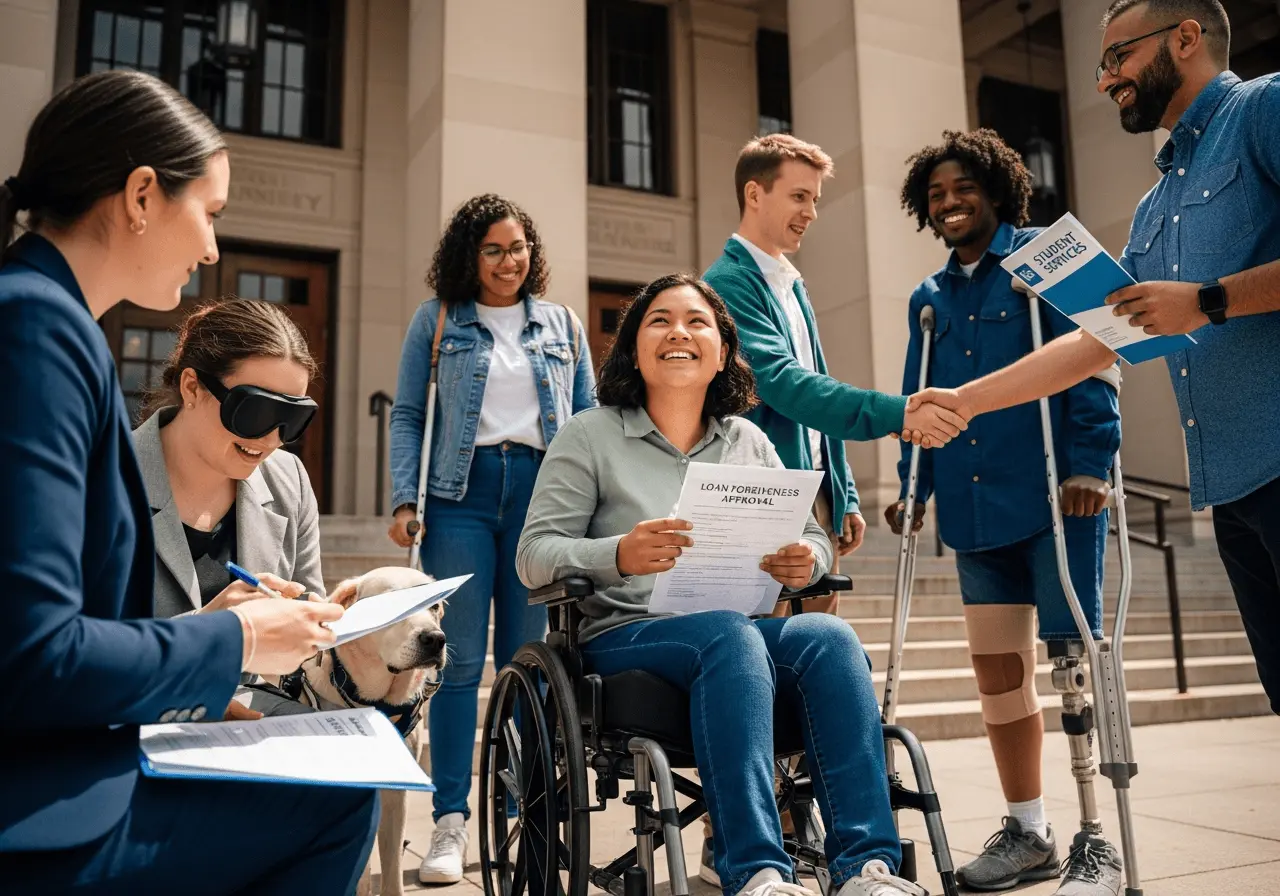

Student loan forgiveness for people with disabilities is officially called total and permanent disability (TPD) discharge. Federal Student Aid decides. We document. Federal Student Aid reviews every application and decides who qualifies, while Rocket Records helps you gather the medical records you need. We do not forgive loans.
How Much Student Loan Debt Do People With Disabilities Carry?
The numbers are larger than most people expect.
According to the Institute for College Access and Success, about 3.59 million people aged 60 and older have federal student loan debt. Together, they owe $155 billion.
That number includes 89,800 borrowers aged 81 and older. They carry $2.6 billion in debt between them.
Many of these older borrowers have disabilities. And many of those disabilities would qualify them for a full loan discharge.
Here is why this matters. Two out of every five adults aged 65 and older have a serious disability. This means a large and growing number of federal loan borrowers may already qualify for TPD relief. They just do not know it yet.
According to the Student Borrower Protection Center, hundreds of thousands of borrowers qualify to have their loans fully canceled. This includes about 42,000 veterans.
But most eligible borrowers have never applied. Many did not know the program existed. Others thought the process was too hard.
The gap between who qualifies and who actually applies is one of the largest unclaimed benefit opportunities in the entire disability space.
The federal student loan portfolio covers about 38 million borrowers. This is noted in the Department of Education’s Unified Servicing and Data Solution program documentation.
For those with qualifying disabilities, TPD discharge means a complete and permanent end to their student loan obligation. Not a deferral. Not a repayment plan. A full discharge with no future obligation.
What Is TPD Discharge and How Does It Work?
TPD discharge is a federal program. It cancels federal student loan debt for borrowers who have a physical or mental disability that severely limits their ability to work.
According to the Federal Student Aid TPD discharge guide, you must show that your disability makes you unable to engage in any substantial gainful activity (SGA).
SGA means work done for pay or profit. It involves significant physical or mental activity.
You do not need to be completely unable to do anything. The legal standard is about sustaining work in a real competitive job setting.
A person who can do light tasks at home but cannot keep a job or maintain consistent attendance may fully qualify.
The TPD program is run separately from all other federal and state disability programs.
Qualifying for SSDI, SSI, or VA disability does not automatically give you a TPD discharge. And getting a TPD discharge does not affect your eligibility for any other benefit program.
Since March 23, 2025, the TPD discharge process has fully moved to Federal Student Aid’s Unified Servicing and Data Solution platform. All applications, status tracking, and discharge processing are now handled through StudentAid.gov.
This change was completed based on a timeline in the Department of Education’s April 2025 electronic announcement.
Three Ways to Qualify for TPD Discharge
Pathway 1: VA Disability Determination
Veterans who have been found by the Department of Veterans Affairs to have a service-connected disability rated at 100 percent may qualify. Veterans rated as totally disabled based on an Individual Unemployability determination also qualify.
This is the most direct path for eligible veterans.
The Department of Education works with the VA each quarter. They find qualifying borrowers and send them automatic notification letters.
If you think you qualify but have not received a letter, you can still apply directly without waiting.
Veterans who get a discharge through the VA pathway are exempt from the standard three-year post-discharge monitoring period. This is because service-connected disabilities are considered permanent.
Keep in mind that a 0 percent service-connected disability rating does not qualify. The VA determination must specifically state that you are 100 percent service-connected disabled. Or it must state that you are totally disabled based on Individual Unemployability.
Veterans with lower ratings who have other qualifying disabilities may still apply through the SSA or physician certification pathways.
Pathway 2: SSA Disability Determination
Borrowers who receive Social Security Disability Insurance (SSDI) or Supplemental Security Income (SSI) may qualify through the SSA pathway. But not every SSDI or SSI recipient automatically qualifies.
You must meet one of these three specific conditions:
-
Your next continuing disability review is scheduled within five to seven years from your last SSA disability determination
-
Your next review is scheduled at the three-year interval, which is used for conditions not expected to improve
-
Your medical onset date for SSDI or SSI is at least five years before the date of your TPD application
These criteria are designed to find borrowers whose disability is expected to be permanent.
The Department of Education works with the SSA to find qualifying borrowers through data matching. They send notification letters to those identified.
As Student Defense has documented, the SSA identified over 818,000 borrowers as potentially entitled to TPD discharge. More than 517,000 of them had not yet received the discharge.
If you think you meet the SSA criteria but have not received a notification letter, you can apply directly. Submit your application at StudentAid.gov with a copy of your SSA notice of award or Benefits Planning Query document. This document must show your applicable review schedule.
Pathway 3: Physician Certification
If you do not have a qualifying VA or SSA determination, you can still qualify through physician certification.
The certifying medical professional must be licensed to practice in the United States. They must be one of the following:
-
Doctor of medicine
-
Doctor of osteopathic medicine
-
Nurse practitioner
-
Physician assistant
-
Certified psychologist
They must certify that you are unable to engage in any substantial gainful activity. This must be due to a medically determinable physical or mental impairment that meets one of these conditions:
-
Has lasted continuously for at least 60 months
-
Can be expected to last continuously for at least 60 months
-
Can be expected to result in death
According to the Federal Student Aid TPD guide, the physician must document two things. First, that the impairment exists. Second, that it limits your ability to work.
The certification can be completed in two ways:
-
A paper form mailed or uploaded to StudentAid.gov
-
A digital option where you enter the medical professional’s email address and they receive a DocuSign request
The digital process is much easier for both you and your doctor.
What Loans and Obligations Are Covered?
The TPD discharge program covers a wide range of federal education debt.
Covered loan types include:
-
All loans under the William D. Ford Federal Direct Loan Program. This includes Direct Subsidized Loans, Direct Unsubsidized Loans, Direct PLUS Loans, and Direct Consolidation Loans
-
All Federal Family Education Loan (FFEL) Program loans. This includes Federal Stafford Loans, Federal PLUS Loans, Federal Consolidation Loans, and Federal Supplemental Loans for Students
-
Federal Perkins Loans
-
National Direct Student Loans
-
National Defense Student Loans
TEACH Grant service obligations are also covered.
A TEACH Grant recipient agrees to complete a teaching service requirement in exchange for grant funding. If that requirement is not completed, the grant converts to a loan.
For borrowers with qualifying disabilities, a TPD discharge eliminates the obligation to complete the service requirement. This is permanent.
Private student loans are not covered.
The program only applies to federal student loans under the Higher Education Act of 1965.
If you have private student loan debt, contact your private lender directly. Ask if they have their own disability discharge provisions. These vary by lender and are not required by federal law.
Student loan forgiveness for students with disabilities is just one of many programs you may qualify for. Rocket Records uses AI to check 25+ federal, state, and local benefit programs based on your health conditions at the same time. It handles all the paperwork too. Most users find over $12,000 in annual benefits they were not claiming. Start your free benefits check at Rocket Records today.
How to Apply for TPD Discharge: Step by Step
The TPD discharge process is now fully handled through StudentAid.gov. Here are the steps as of 2026.
Step 1: Find your eligibility pathway.
Decide which of the three paths fits your situation. These are VA determination, SSA determination, or physician certification.
If you have both a VA rating and SSA benefits, the VA pathway is usually the most direct. It does not require a post-discharge monitoring period.
Step 2: Gather your documents.
-
For the VA pathway: Get your VA determination letter. It must confirm 100 percent service-connected disability or Individual Unemployability
-
For the SSA pathway: Get your SSA notice of award or Benefits Planning Query document
-
For the physician pathway: Find a licensed qualifying medical professional who can certify your disability
Step 3: Log in to StudentAid.gov.
Create or access your Federal Student Aid account at StudentAid.gov using your FSA ID. You can submit and track your application through the portal.
Step 4: Complete and submit your application.
Fill out the form with your personal information, loan details, and supporting documents.
If using the physician pathway, enter the medical professional’s email address for DocuSign certification. Upload or mail all required documents.
Step 5: Enter the forbearance period.
Once your application is received, your loan servicer will pause your loan payments. This is called forbearance. No payments are required during this time.
But interest continues to build on unsubsidized loans during forbearance.
Step 6: Get your discharge decision.
If approved, your entire outstanding loan balance is discharged.
If denied, you will get a written notice explaining why. You can reapply if your situation changes or if you can provide stronger documentation.
Rocket Records helps you gather the medical records your application needs for TPD discharge for student loans. If you are still in school, you can also get support with student disability accommodations.
The Post-Discharge Monitoring Period
Borrowers who receive TPD discharge through the SSA pathway or physician certification pathway enter a three-year post-discharge monitoring period. This starts on the date your discharge is granted.
During this period, the Department of Education monitors your situation. They check if anything has changed that would suggest your disability no longer qualifies.
Specific events that can trigger reinstatement of your loan include:
-
Earning income above the SGA threshold. In 2026, this is $1,690 per month for non-blind individuals
-
Taking out a new federal student loan
-
Getting a notice that your SSA determination has been reviewed and reversed
The three-year monitoring period does not apply to veterans who qualify through the VA pathway.
During the monitoring period, be careful about starting a new job or increasing your work hours. If your earnings get close to or exceed the SGA limit, a review may be triggered.
Talk to a financial counselor or disability advocate before making big employment changes during this period.
If your loan is reinstated due to a monitoring period issue, you will be notified in writing. You must then resume payments under your original loan terms.
Tax Treatment of TPD Discharge
Many borrowers worry about taxes after getting a TPD discharge. Here is what you need to know.
According to the Federal Student Aid MOHELA disability discharge guide, loan balances discharged through TPD on or after January 1, 2018 are not counted as income for federal tax purposes.
If you receive a Form 1099-C showing the discharged amount, keep it for your records. But you do not need to include it when filing your federal tax return.
Important dates to know:
-
For VA-pathway discharges: The tax-relevant date is when the Department of Education approves your application
-
For SSA-pathway and physician-certification discharges: The tax-relevant date is when the three-year post-discharge monitoring period ends
State taxes are a different story.
State tax treatment of TPD discharge varies a lot. Some states may count the discharged amount as taxable income for state returns.
Talk to a state tax professional or your state revenue office before filing if you receive a TPD discharge.
Common Reasons TPD Applications Are Denied
Knowing why applications get denied helps you avoid common mistakes.
Physician pathway: Incomplete medical certification
This is the most common reason for denial on this pathway.
The certifying clinician must confirm two things:
-
That you have a medically determinable impairment
-
That this impairment affects your ability to engage in substantial gainful activity
A note that simply says the patient has a disability is not enough. It must address the SGA standard directly.
The Institute for College Access and Success notes that medical professionals sometimes fill out the form incorrectly. This often happens because they are not familiar with the specific legal standard the form applies.
SSA pathway: Wrong documentation
Sending only an SSA award letter is not enough if it does not confirm the required review schedule timing.
Ask the SSA specifically for a Benefits Planning Query document. This contains the detailed review scheduling information the Department of Education needs.
All pathways: Personal information errors
Missing or inconsistent personal information causes delays or rejections.
Your name, Social Security number, and address must exactly match your records in the federal student loan system. Even small errors can prevent your application from being processed.
Other Loan Forgiveness Options for Disabled Students
Public Service Loan Forgiveness
Borrowers with disabilities who still work in qualifying public service jobs may also be eligible for Public Service Loan Forgiveness (PSLF).
This program cancels the remaining balance on Direct Loans after 120 qualifying monthly payments. You must work full-time for a qualifying government or nonprofit employer.
The final PSLF regulations published on October 30, 2025 will be effective July 1, 2026.
If you qualify for both TPD discharge and PSLF, TPD discharge is usually the better option when you cannot maintain qualifying employment. PSLF may be better if you are still employed and close to the 120-payment threshold.
Income-Driven Repayment Plans
If you do not qualify for TPD discharge, income-driven repayment (IDR) plans may help.
These plans set your monthly payment as a percentage of your discretionary income. If you have little or no income due to disability, your monthly payment may be zero dollars. Your loans stay in good standing during this time.
After 20 to 25 years of qualifying payments, the remaining balance is forgiven.
The SAVE plan was ended by a court order on March 10, 2026. But other IDR options are still available. These include Income-Based Repayment, Pay As You Earn, and Income-Contingent Repayment. You can find these through the StudentAid repayment plans page.
Closed School Discharge
If you attended a school that closed while you were enrolled, or shortly after you left, you may qualify for a closed school discharge.
According to Federal Student Aid forgiveness and cancellation options, this discharge is available regardless of disability status. It covers Direct Loans and FFEL Program loans.
If your school closed and you are also eligible for TPD discharge, it may be possible to receive relief through both programs separately.
How Rocket Records Helps Disabled Borrowers Get Every Benefit
Getting a TPD discharge eliminates your student loan debt. But for most people with a qualifying disability, it is just one of many benefits they are entitled to.
Other benefits that may apply to you include:
-
SSDI income support
-
SSI for those with limited income
-
Medicaid health coverage
-
Medicare after SSDI approval
-
Property tax exemptions
-
Prescription assistance programs
-
Utility assistance
-
Accessible parking permits
-
FMLA workplace protections
None of these programs connect automatically to a TPD discharge. Each one requires a separate application through a different federal or state agency.
Rocket Records was built to fix this problem.
The platform uses AI to match your health conditions against 25 or more benefit programs at the same time. For a borrower who has just applied for or received a TPD discharge, a single five-minute session can typically find additional eligibility for:
-
SSDI or SSI income programs
-
Medicaid services
-
Prescription cost reduction
-
Property tax relief
-
Utility assistance
-
State-level disability programs
The platform pre-fills applications for each program you qualify for. It also gives you a personal benefits dashboard.
Most users find over $12,000 in annual benefits they were not previously claiming.
Your qualifying disability may entitle you to TPD discharge, SSDI income, Medicaid, property tax relief, prescription savings, and more. But each program requires its own separate application.
Rocket Records finds every benefit you qualify for, handles all the paperwork, and delivers your full dashboard in under five minutes. Discover your complete disability benefits package at Rocket Records today. Free to start, with most users unlocking over $12,000 in annual benefits.






 Ask ChatGPT
  Ask Claude
  Ask Perplexity