

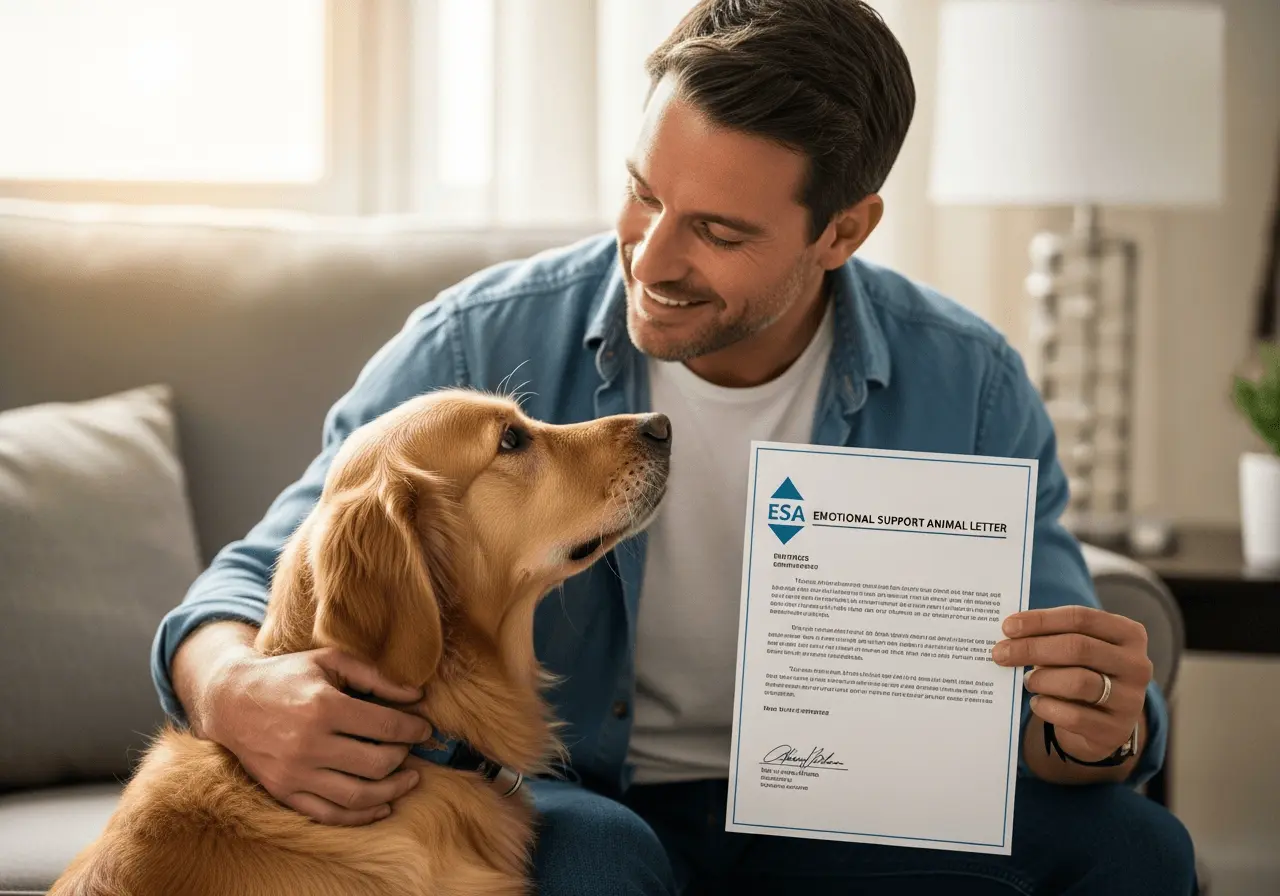

ESA letter requirements for housing are different from airline rules, so a letter that works for your apartment won’t get your animal on a plane. Your housing provider reviews your letter and makes the final decision. Rocket Records provides the letter through a licensed mental health professional, but we can’t guarantee any landlord will accept it. This guide covers what a valid housing ESA letter must include and how the rules change from state to state.
What Federal Law Says About ESA Letter Requirements
At the federal level, emotional support animals are protected primarily under the Fair Housing Act (FHA), which is administered by the U.S. Department of Housing and Urban Development. Under the FHA, a housing provider must allow a reasonable accommodation involving an assistance animal when a request is made by or for a person with a disability whose disability affects a major life activity and who has a disability-related need for the animal. As HUD makes clear, an assistance animal is not a pet. It is an animal that works, provides assistance, or performs tasks for the benefit of a person with a disability, or provides emotional support that alleviates one or more identified effects of a person’s disability.
A critical distinction separates ESAs from service animals. According to ADA, emotional support, therapy, comfort, and companion animals do not qualify as service animals under the Americans with Disabilities Act because they have not been trained to perform a specific job or task directly related to a person’s disability. The ADA covers service animals in public spaces, while the FHA governs ESA housing protections. ESA owners have housing rights but do not have ADA-based public access rights for their animals.
HUD’s Assistance Animals Fact Sheet is particularly important for understanding documentation standards. HUD has explicitly stated that documentation from websites that sell certificates, registrations, and licensing documents to anyone who answers certain questions and pays a fee is not sufficient to reliably establish that an individual has a non-observable disability or disability-related need for an assistance animal. A valid ESA letter must come from a licensed healthcare professional who has personal knowledge of the individual and their condition.
The Department of Justice further reinforces this framework. Under ADA Title II regulations, emotional support animals that do not qualify as service animals under ADA rules may nevertheless qualify as permitted reasonable accommodations under the Fair Housing Act. This means public housing authorities must apply FHA reasonable accommodation requirements when evaluating ESA requests and may not use the stricter ADA service animal definition to reduce their FHA obligations.
Core ESA Letter Requirements That Apply in Every State
Regardless of which state you live in, there are universal ESA letter requirements that every document must satisfy to be legally recognized under the Fair Housing Act. According to HUD’s guidance and California’s Civil Rights Department FAQ on ESAs, missing any of the following elements gives a housing provider grounds to request additional documentation or to deny the accommodation request.
A Licensed Mental Health Professional Must Write the Letter
Only a licensed mental health professional (LMHP) or licensed healthcare practitioner can issue a legally valid ESA letter. Qualifying professionals include psychiatrists, psychologists, licensed clinical social workers, licensed professional counselors, and licensed marriage and family therapists. The California Board of Behavioral Sciences confirms under California AB 468 that health care practitioners must have a valid, active license and must include their license effective date, license number, jurisdiction, and type of professional license in any ESA documentation they provide. A general physician may write the letter, but the practitioner must have personal knowledge of the patient’s condition.
Official Letterhead and Complete Provider Credentials
The letter must appear on formal letterhead from a licensed mental health practice and must include the provider’s full legal name, license type, license number, state of licensure, business address, and contact information. This allows housing providers to verify the issuing professional’s credentials independently. HUD’s guidance notes that documentation is considered reliable when it is provided by legitimate, licensed health care professionals delivering health care services with personal knowledge of the individual, including services delivered remotely via telehealth.
Diagnosis Statement Confirming a Qualifying Disability
The letter must confirm that the individual has a diagnosed mental health condition that substantially limits one or more major life activities. The FHA defines a person with a disability as someone who has a physical or mental impairment which substantially limits one or more major life activities, a record of having such an impairment, or who is regarded as having such an impairment. Under HUD’s Fair Housing Guidebook, qualifying conditions include orthopedic impairments, epilepsy, diabetes, cancer, HIV infection, intellectual disabilities, emotional illness, and more. The letter does not need to name the specific diagnosis, but must confirm that a qualifying condition exists.
Clear ESA Recommendation and Annual Renewal
The letter must contain an explicit recommendation that an emotional support animal is part of the individual’s treatment plan and that the animal helps alleviate symptoms of the condition. The letter must also be dated. While the FHA does not specify an expiration date, annual renewal is the widely accepted standard, and many state laws and housing providers require documentation dated within the past 12 months. Under Florida Statute 760.27, information from a healthcare practitioner is considered reliable only when the practitioner has personal knowledge of the person’s disability and is acting within the current scope of their practice.
Does your mental health condition qualify for an ESA letter? My Rocket Records matches your conditions to ESA documentation and 25+ other benefits: Check Your ESA Eligibility at Rocket Records
ESA Letter by State: How Requirements Vary Across the States
While federal law sets the baseline, ESA letter by state rules can add meaningful requirements on top of the FHA standard. Understanding your state’s specific laws before applying prevents delays and denials. States fall into three broad categories based on their regulatory approach.
States Requiring a 30-Day Provider Relationship
Five states require a documented therapeutic relationship of at least 30 days before a licensed professional may issue an ESA letter. These are California, Arkansas, Iowa, Louisiana, and Montana. California’s requirement is codified in Assembly Bill 468 (Health and Safety Code Section 122318), which mandates that a healthcare practitioner must establish a client-provider relationship for at least 30 days prior to providing documentation, complete a clinical evaluation specific to the individual’s need for an emotional support dog, and include their license effective date, license number, jurisdiction, and license type in the documentation. The California Civil Rights Department has further clarified that businesses claiming to register or certify ESAs are charging for a service that is unnecessary and that the only valid form of documentation is a proper ESA letter from a licensed provider.
Montana’s HB 703 mirrors this 30-day standard and also allows landlords to request supporting information regarding the need for the animal. Iowa under Iowa Code Section 216.8C and Arkansas under HB 1420 carry the same mandate. Louisiana similarly requires an established therapeutic relationship before documentation can be issued. Residents of these five states must begin working with a licensed provider well in advance of any housing application or lease renewal deadline.
States With Additional Verification Requirements
Several states have enacted laws that tighten ESA documentation standards without imposing the full 30-day rule. Florida’s Statute 760.27 (Florida Senate) establishes that supporting information from a healthcare practitioner is only considered reliable if the practitioner has personal knowledge of the person’s disability and is acting within the scope of their practice. Florida also created a separate criminal statute, Section 817.27, making false or fraudulent proof of need for an ESA a second-degree misdemeanor punishable by up to 60 days in county jail and a fine.
Colorado requires a bona fide provider-patient relationship before any ESA recommendation letter can be issued, as confirmed by the Colorado Division of Professions and Occupations. Under Colorado Revised Statutes Section 12-245-229 and 12-255-133, a licensee may not make a determination regarding the need for an ESA unless the licensee has met with the patient in person or, for physicians, by telemedicine. This requirement applies across mental health counselors, social workers, psychologists, marriage and family therapists, and nurses, ensuring that no instant-approval or questionnaire-based ESA letters can meet Colorado’s standard.
States Following the Federal Baseline Only
The majority of U.S. states do not add requirements beyond the FHA. In these states, a valid ESA letter from any licensed mental health professional who has conducted a genuine evaluation and confirmed a qualifying condition is sufficient for housing accommodations. States in this category include New York, Texas, Ohio, Georgia, Virginia, Arizona, and most others. However, housing providers in all states retain the right under HUD’s guidance to request reliable third-party documentation when the disability-related need for an ESA is not readily apparent. The ADA also clarifies that some state and local laws define assistance animals more broadly than federal law, and individuals may check with their State Attorney General’s office for additional state-level protections.
How to Get a Compliant ESA Letter in 2026
Obtaining a compliant ESA letter in 2026 involves four clear steps: confirming you have a qualifying mental health condition, identifying a licensed provider in your state, completing a legitimate clinical evaluation, and receiving properly formatted documentation. The process begins with an honest assessment of your mental health. Qualifying conditions under the FHA include, but are not limited to, anxiety disorders, depression, PTSD, bipolar disorder, panic disorder, autism spectrum conditions, and any other diagnosed condition that substantially limits a major life activity.
For individuals who also need employment protections during their mental health treatment, FMLADocs provides online FMLA certification through licensed healthcare providers, allowing employees with qualifying mental health conditions to secure up to 12 weeks of job-protected leave per year under the Family and Medical Leave Act. FMLA certification and an ESA letter address different aspects of the same disability, housing and employment, and both require documentation from a licensed professional who has personal knowledge of the individual’s condition. FMLADocs completes certifications within 24 to 48 hours and ensures full federal compliance.
Once you receive your ESA letter, submit a copy to your housing provider along with a written reasonable accommodation request. Under the FHA, the housing provider may verify the provider’s license but cannot ask about the specific details of your diagnosis, require full medical records, or charge pet fees or deposits for your ESA. HUD’s guidance makes clear that landlords cannot refuse a reasonable accommodation request that is supported by reliable third-party documentation from a licensed professional who has personal knowledge of the individual. A platform like Rocket Records can help you identify your full range of eligible benefits, including ESA documentation, tax credits, Medicaid, FMLA, and more, all in one place.
Ready to get started? You can request an emotional support animal letter from a licensed provider through Rocket Records. ESA letter for housing explains how to submit it to your landlord and what happens next.
Common ESA Letter Mistakes That Lead to Rejection
Even with a legitimate provider, certain documentation errors frequently lead to housing provider rejections. The most common mistake is submitting a certificate or registration purchased online in place of a proper ESA letter. HUD has explicitly stated in its Assistance Animals Notice FHEO-2020-01 that commercially available documentation from websites that sell credentials to anyone who answers questions and pays a fee is not sufficient to reliably establish disability-related need. There is no national ESA registry, and any document sold as an ESA registration, certificate, or ID card carries no legal standing whatsoever.
The second most common error is submitting a letter with missing or incomplete provider credentials. If the license number, state of licensure, or contact information is absent, housing providers cannot verify the letter and may legally request additional documentation or deny the request. Other frequent errors include submitting a letter issued more than 12 months ago, using a provider licensed in a different state than where the housing is located, failing to include a clear ESA recommendation statement, and not accounting for state-specific rules. In California, failing to meet the 30-day relationship requirement under AB 468 or submitting a letter from an out-of-state provider violates state law regardless of whether the letter otherwise meets federal FHA standards. In Florida, using a provider who has no personal knowledge of the patient’s disability as required by Florida Statute 760.27 will result in the letter being considered unreliable by the housing provider.
Always verify your state’s current ESA letter requirements before submitting any documentation, and ensure your provider is licensed in your state, has personally evaluated you, and has included all required elements on their official letterhead.






 Ask ChatGPT
  Ask Claude
  Ask Perplexity